What Are Oak “Apples”?

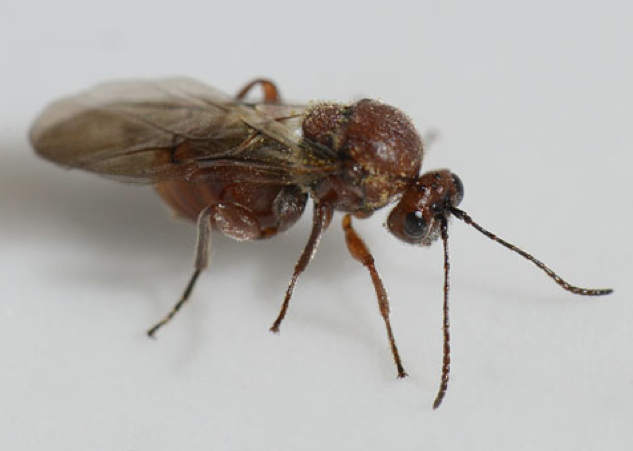
A Frequently Asked Question                                                                                                    Visitors to the Granada Native Garden often ask about those golf ball- or tennis ball-size globes in the branches of our California white oak trees, or valley oaks (Quercus lobata).  These growths are often called “oak apples”.  But real apples don’t grow on oak trees.  Actually, the growths that we see are called oak galls.  Not apples at all, they are caused by tiny brown California oak gall wasps which parasitize the oak tree, altho without actually harming the tree.  (Just click on the photos to enlarge them!)

New galls in the spring

New galls in the spring

Oak apples in the fall
Oak apples in the fall


An oak apple gall wasp

An oak apple gall wasp

Galls are common features on other plants as well, such as poplar and cottonwood, but they are more readily noticed on the valley oak.  The California gall wasp (Andricus quercuscalifornicus) inserts fertilized or unfertilized eggs under the bark of oak twigs.  Larvae which develop from the eggs are thought to secrete chemicals that cause the oak tree to respond defensively by growing plant tissue around the infection site, eventually forming the round growth, the oak “apple”.  The galls are green in the spring, and turn to brown in the summer and fall.  Each gall may contain one or more wasp larvae.  The larvae mature and nourish themselves with the nutritive tissue of the galls, and eventually tunnel their way out of the gall as adults.  In the meantime, the styrofoam-like interior of the gall functions as a cozy habitat for the developing wasps during the hot summer months.                     Eventually, the galls fall off, and the tree doesn’t appear to be harmed in any way.
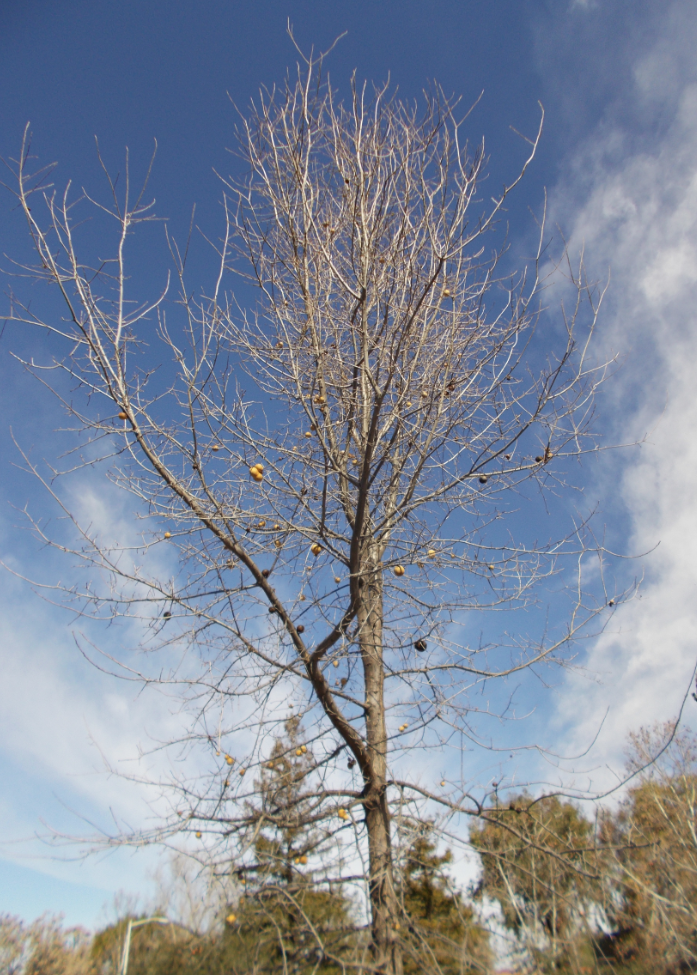
Oak apples on a tree in winter

Oak apples on a tree in winter

Inside an oak apple gall

Inside an oak apple gall


The “Elder Statesman” of California’s Oaks
The California white oak, or valley oak, made a big impression on the Europeans who first explored this part of the country.  Some sites contained hundreds or thousands of these huge trees, which commonly rose to 40-100 feet in height and 9 feet in diameter.

A stately valley oak at Sycamore Grove Park

A stately valley oak at Sycamore Grove Park

The Franciscan missionary Narcisco Durán described the environment of the Sacramento River as “like a park, because of the verdure and luxuriance of its groves of trees”.  After viewing an expanse of valley oaks in the Santa Clara Valley, the English explorer George Vancouver recorded his impression:  “For about twenty miles it could only be compared to a park which had originally been closely planted with the true old English oak; the underwood, that had probably attended its early growth, had the appearance of having been cleared away and left the stately lords of the forest in complete possession of the soil which was covered with luxuriant foliage.”                                                                                       But the dramatic character of the valley oak was no match for the effects of “civilization” which followed the European invasion.  Altho the valley oak tolerates cool wet winters and hot dry summers, it is a riparian species that requires a year-round deep source of ground water.  As a result, when the water table is lowered because water is pumped out to supply the needs of ever-growing human populations, the oaks are unable to reach the water they need to survive.                                                                                           On the other hand, when California oaks are planted in landscaping projects along with other plants that need constant summer water, such as non-native grasses, ivy, azaleas and rhododendrons, these plants develop thick mats of roots which inhibit the exchange of air and water that the native oaks are accustomed to.  Furthermore, when oaks are watered in the summer, they are likely to die from the oak root fungus, Armillaria, which is common in the root systems of most oaks in California.

Native Americans and the Valley Oaks                                                                             “To native people, these regal trees marked the seeming timelessness of the earth and also the continuity of life.  They were massive fixtures on the landscape bearing witness to many generations of humans.” (from Tending the Wild, by M. Kat Anderson).                 Acorns are rich in protein, carbohydrates and fats, as well as calcium, magnesium, phosphorus, potassium, sulfur and niacin (vitamin B3).  While they are an important food source for birds and small mammals, humans can eat them too.  One advantage of acorns as food is that they could be stored over the winter when food was scarce.  Acorn flour and recipes using it are easily available thru the Internet.                                                                  But the acorns themselves also contain tannins, which are bitter and can consti- pate the digestive system and interfere with the metabolism of protein.  Different animals have evolved ways to use the nutritional value of acorns and avoid these indelicacies.  One way that Native Americans made use of acorns in their diet was to chop them up, put them into porous baskets, and set the baskets in running water until the water no longer turned brown and the tannins were leached out.  Then the acorns could be dried and pulverized and turned into a nutritious porridge (unappetizingly called acorn mush) or a soup.  John Muir reportedly was fond of a black, hard bread that was made of acorn flour.           In addition, dye for decorating baskets and clothing was made from the bark, and the tannin of acorns was used for curing animal hides.  If the ground acorn meal got moldy, either by chance or intention, the penicillin-like mold could be used to treat boils, sores and inflammations.  Whole acorns could also be used to make musical instruments, necklaces, toys and trade items.

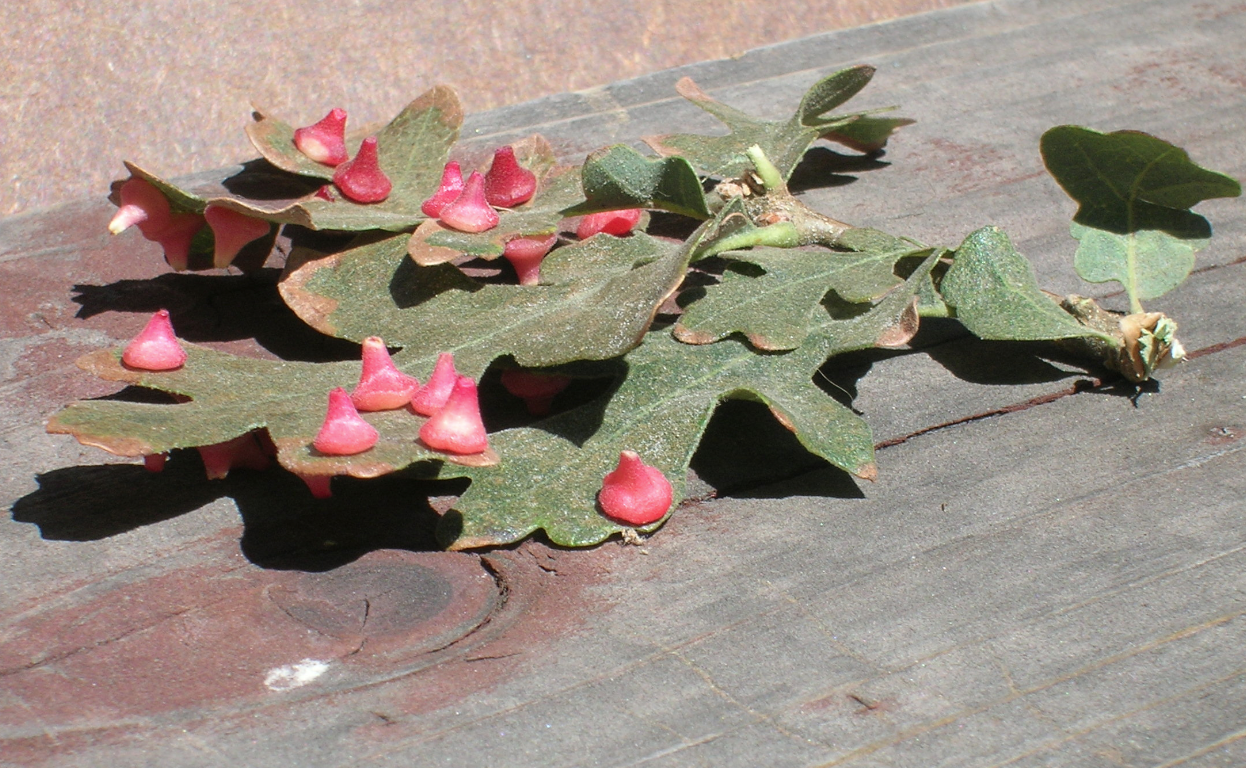
Another Delightfully Interesting Gall!                                                                              Hershey's kisses galls            A different wasp species, Andricus kingi, produces galls of a different and very interesting sort.  The red cone gall wasp creates galls affectionately called the Hershey’s Kiss gall, because of its shape, altho it is much smaller and bright red.  Look for this common gall on the leaves of the valley oaks.  Andricus kingiThey are much smaller than oak apples, but hard to miss because of their bright color.                                          These are only two of many types of galls found on oaks and other trees.  Each one has its own story.  Search the Internet for yourself to learn more about these fascinating organisms, and keep your eye out for growths on California native plants that might be galls of one type or another.     (Thanks to Joyce Gross of U.C. Berkeley for the use of this photo of Andricus kingii).
Quote du Jour:                                                                                                                              “A man has made at least a start on discovering the meaning of human life when he plants shade trees under which he knows full well he will never sit.”
            – D. Elton Trueblood, author and theologian, former chaplain to Stanford University

Screen shot 2014-04-17 at 8.05.51 AM

About “Fire Followers”

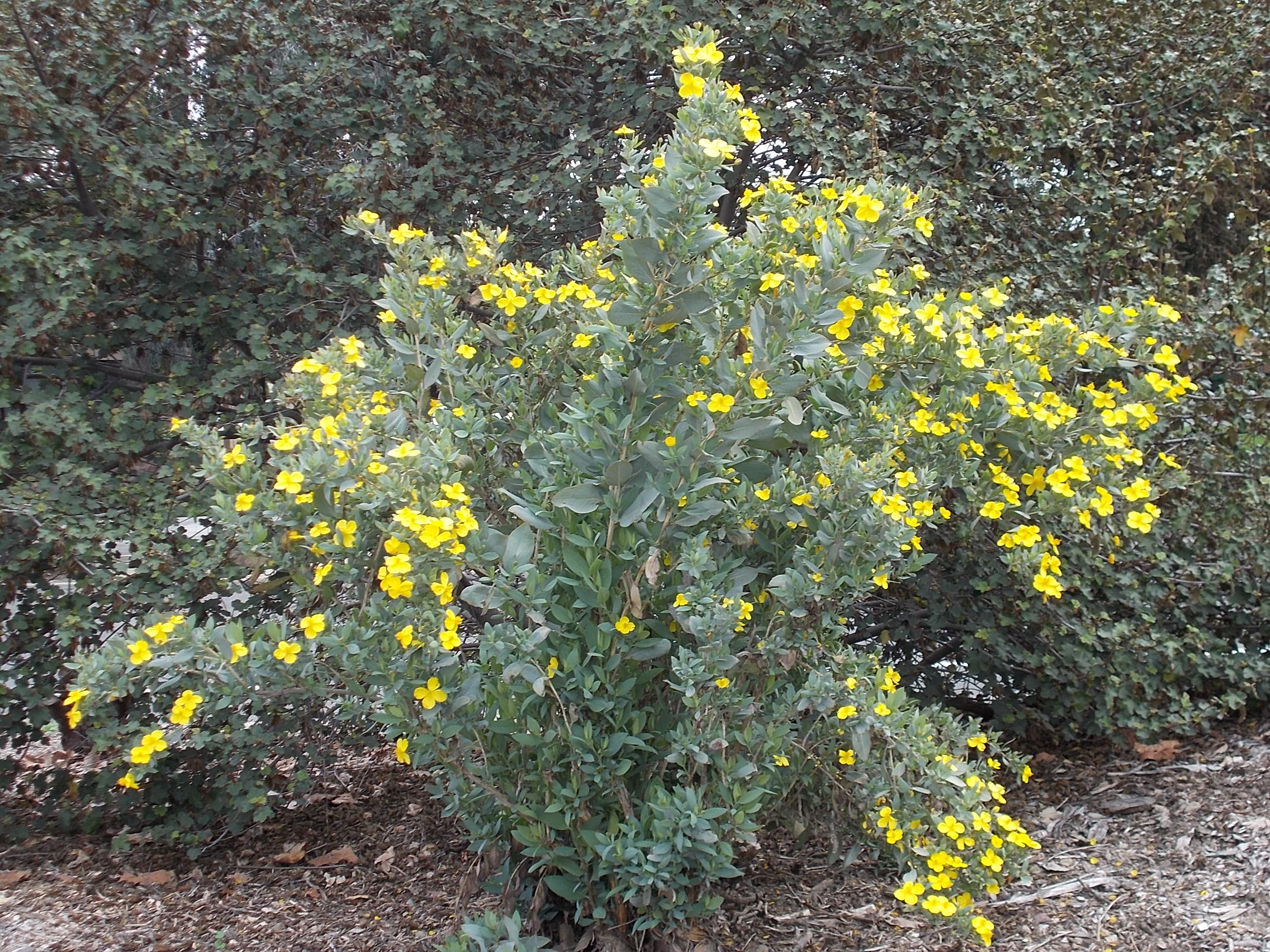
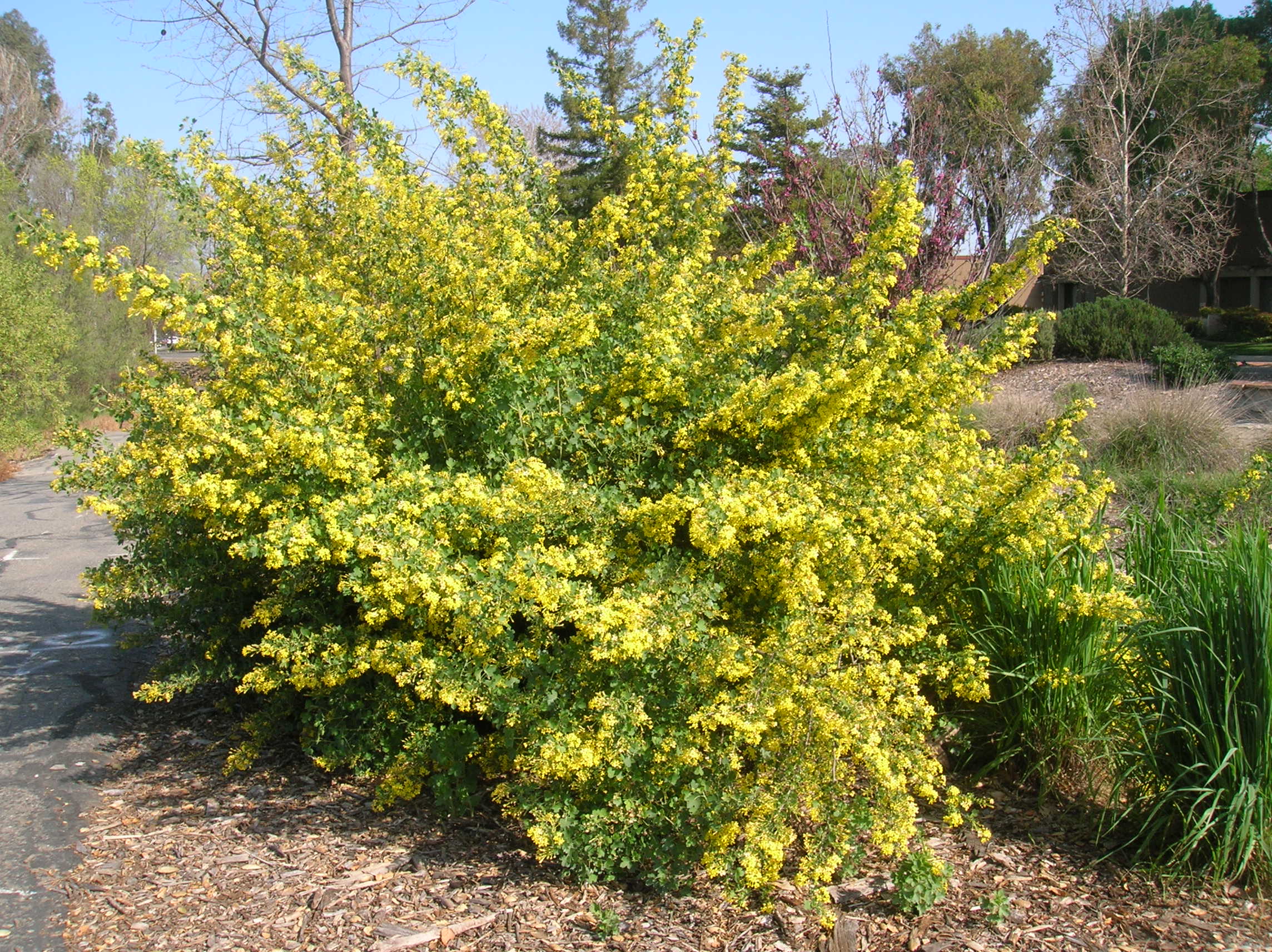
Bush Poppy Is a Fire Follower!Bush poppy          At the end of May, we were working on an article about the bush poppy (Dendromecon rigida) which resides at the north end of the Granada Native Garden.  The bush poppy is interesting for a couple of different reasons.  For one thing, it has bright yellow flowers that remain on the bush for several months, well into summer, and they contrast nicely with the grayish-green foliage.                       But also, the seeds that fall from the mature flowers are difficult to germinate into new plants.  They need to be brushed by fire in order to stimulate the germination process, and so the bush poppy is among the first to appear after a fire.  That’s why the bush poppy is called a “fire follower”; but there are many other plants that also require fire in order to prompt their appearance.  (Click on a photo in order to enlarge it.)

Bush poppy after the fire

Bush poppy after the fire

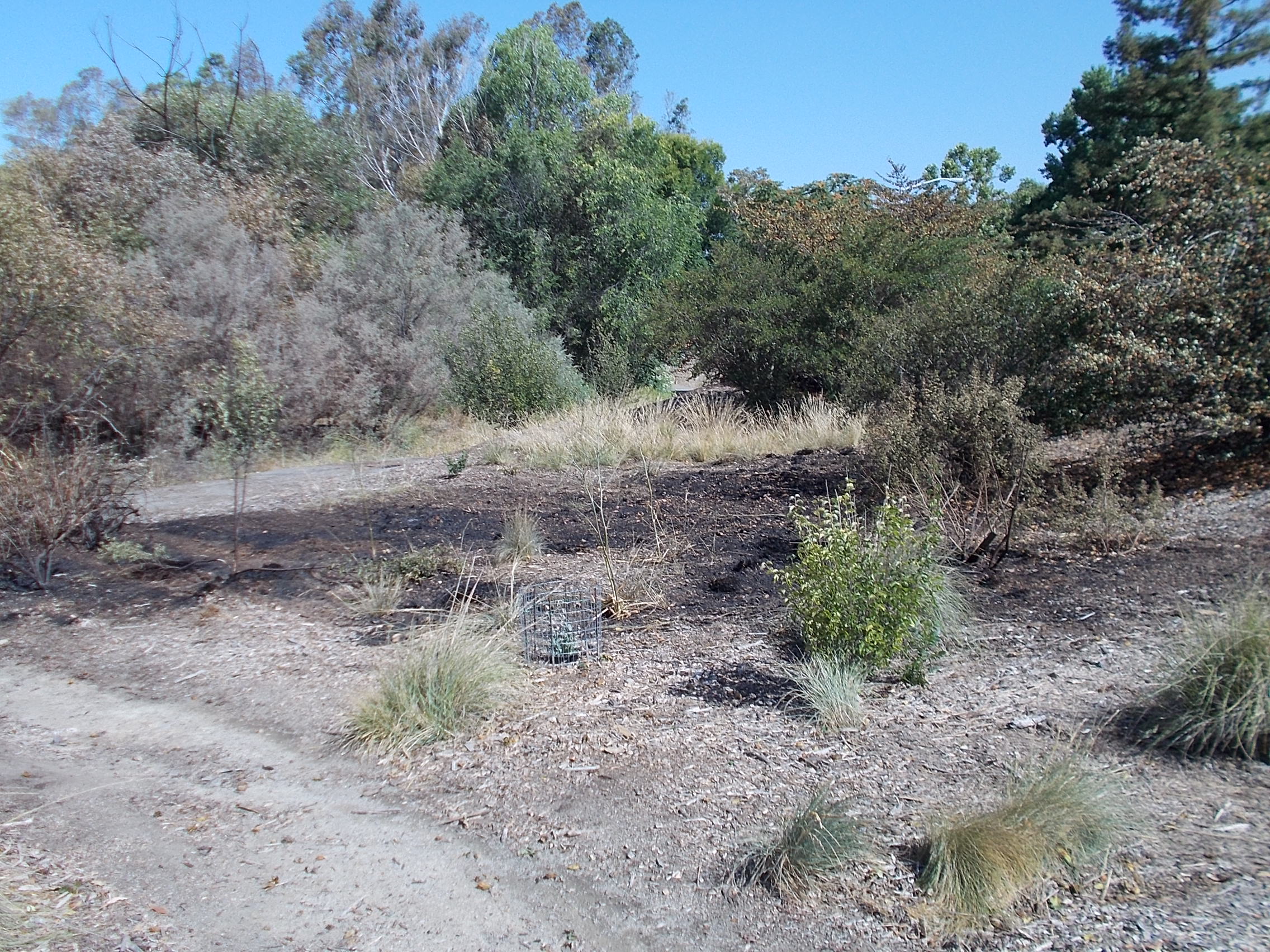
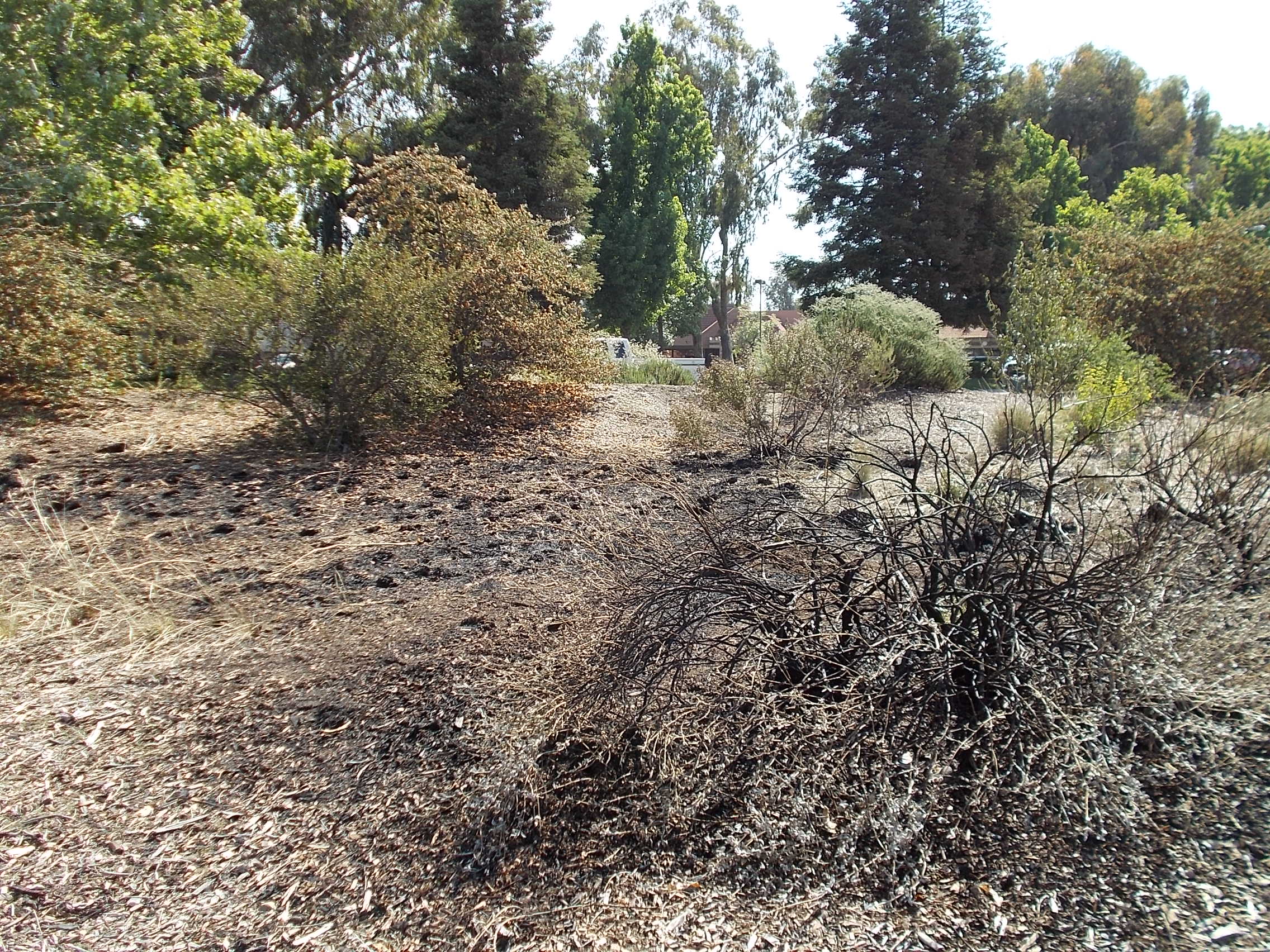
Coincidentally, on June 1,  the GNG was impacted by the fire which was started along the west side of the Arroyo Mocho.  The bush poppy was toasted on one side, not severely, but it will be interesting to see if any seedlings pop up (oops, excuse the pun!) when/if the winter rains occur.  (For a summary of the fire’s effects on the Garden, see the article “Fire! at the Granada Native Garden” posted in the June, 2014 Newsletter.)

Why Is Fire Important?                                                                                                               The natural ecology of many native plants enables them to survive, and even flourish, after a fire.  If they lack the needed conditions for their growth, many native plants may lay dormant in the soil for many years until a fire or some other disturbance triggers the plant’s survival mechanism.                                                                                                                      The tough seed coat of some seeds often protects them from being destroyed in a fire.  But the fire also may crack open the seed coat and allow water to penetrate, giving the seed a chance to germinate.                                                                                                    The ashes of burned wood are rich in potassium, phosphorus, calcium, magnesium and other plant nutrients.  The bodies of  insects, worms and other invertebrates and microbes that have been killed by the fire decompose and gradually release nitrogen into the soil.  Thus, fire creates a slow-release fertilizer available to nourish newly sprouted seeds.  Likewise, fire may destroy plant pests, such as bark beetles, root-eating grubs, and diseases such as anthracnose.  Native Americans used controlled burns precisely to accomplish these goals.                                                                                                                The fire burns off underbrush and allows sunlight needed by seedlings to reach the forest floor.  There is also evidence that smoke itself contains chemicals from combustion products that induce germination.  Finally, annuals and perennials that emerge soon after a fire provide the vegetative cover that helps to reduce the heavy erosion possible on steep mountain slopes after the protective cover has been burned off.

Other Fire Followers

Whispering bells (Emmenanthe penduliflora)

Whispering bells (Emmenanthe penduliflora)

Fire poppy (Papaver californicum)

Fire poppy (Papaver californicum)


Popcorn flower (Plagiobothrys nothofulvus)

Popcorn flower (Plagiobothrys nothofulvus)

Golden eardrops (Dicentra chrysantha)

Golden eardrops (Dicentra chrysantha)


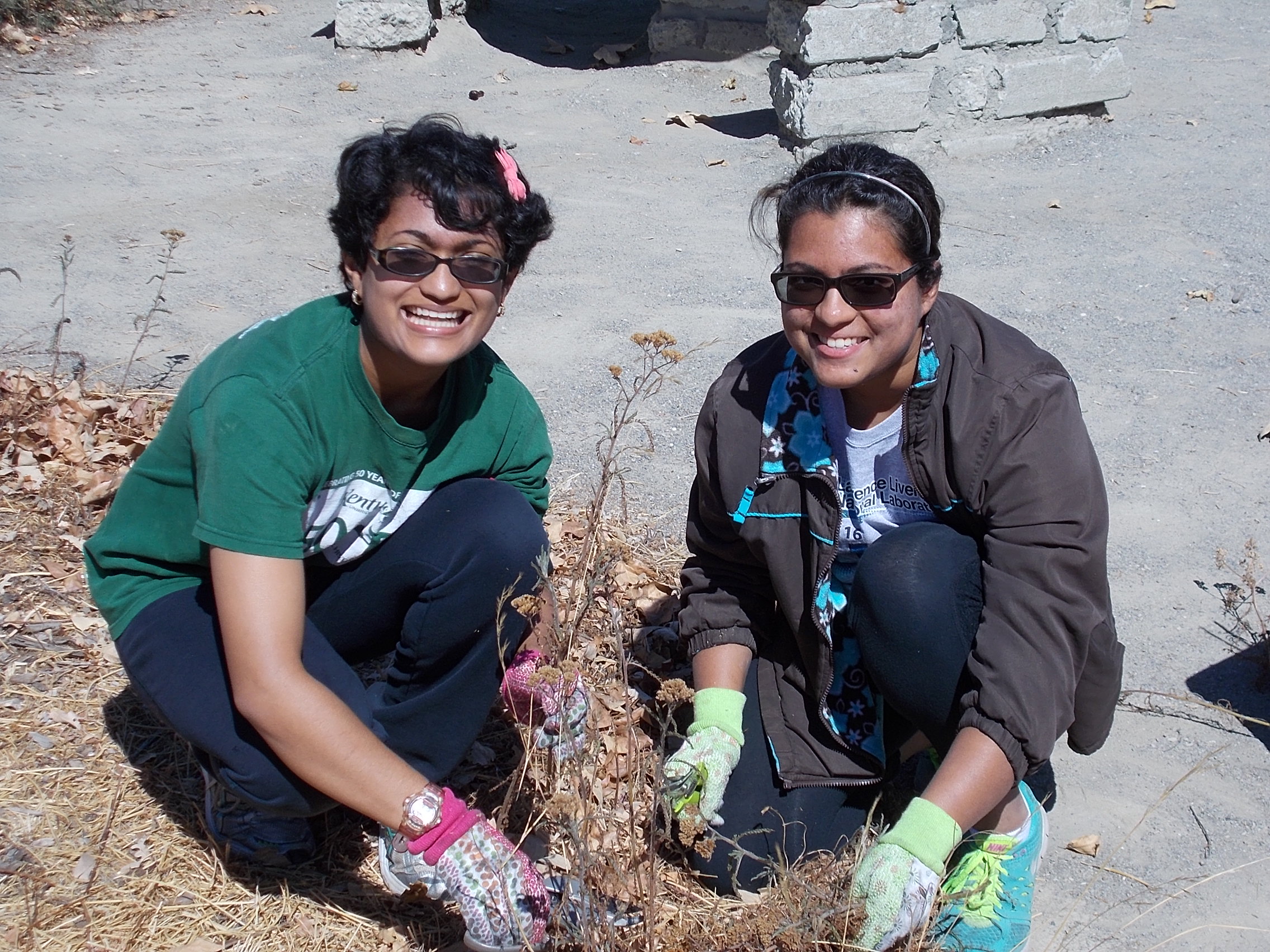
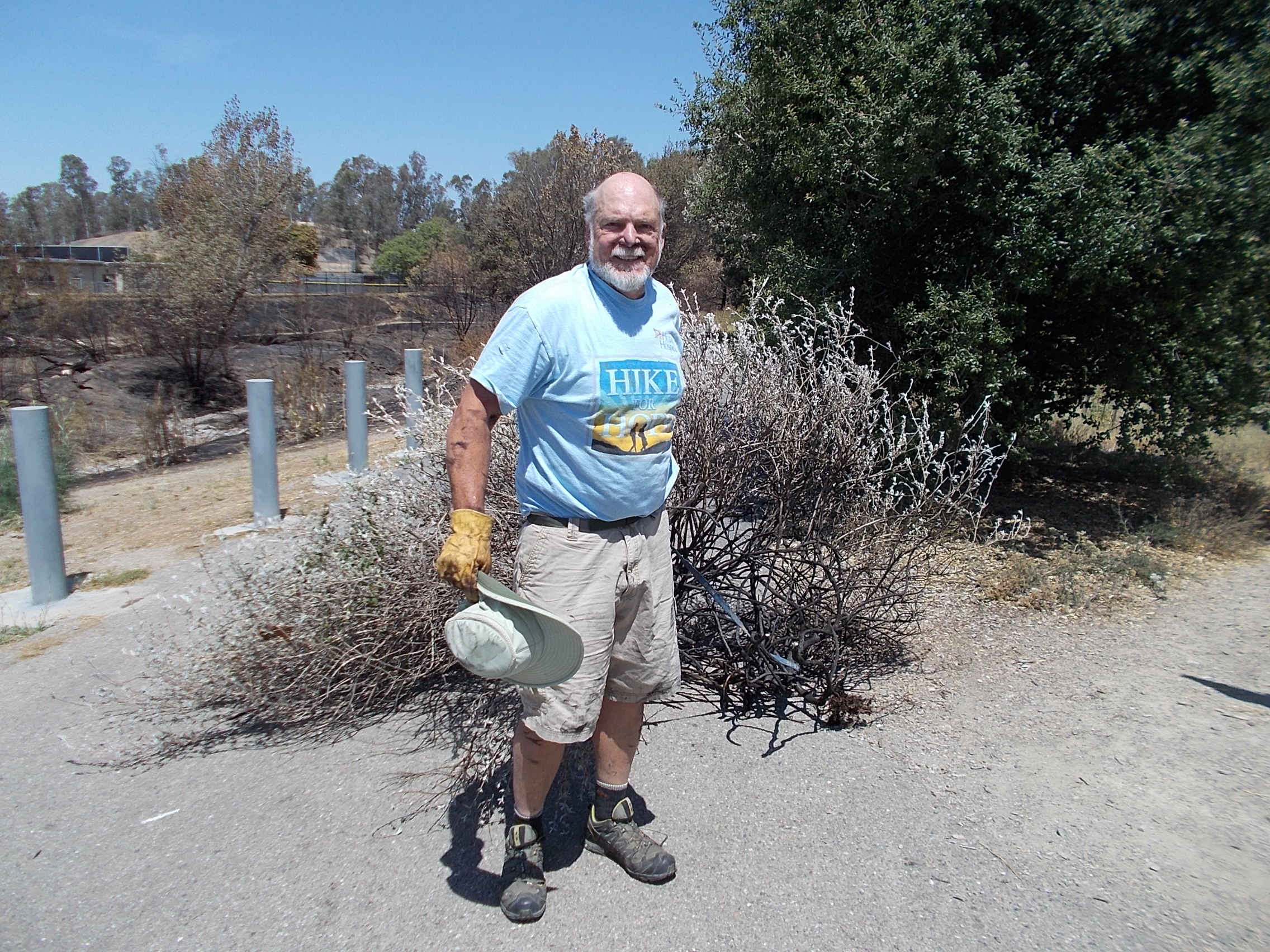
The Cleanup Continues                                                 The worker bees at the Granada Native Garden have been busy removing sage, roses and currants that have been damaged by the fire.  Amazingly, the deergrass (Muhlenbergia rigens), golden currants (Ribes aureum), box elder (Acer negundo), wild roses (Rosa californica) and matilija poppy (Romneya coulteri) are already showing recovery, only one month after the fire.                              Of Meenakshi & Malvikaimmense help in the effort of clearing the debris have been Meenakshi and Malvika, both Granada High School students, who have spent several hours toting burned debris to the brush pileIt’s a dirty job, but somebody has to do it, and Malvika and Meenakshi, along with other GNG worker bees, have stepped up to do it!                                                   

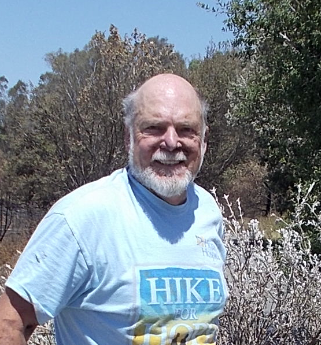
The Adopt-A-Creek Spot Program                                                                                            Closely related to the Granada Native Garden in reclaiming the natural character of this section of the Livermore Valley is the Tri-Valley Adopt-A-Spot Creek program.  The Friends of the Arroyos have adopted a 700-foot section of the Arroyo Mocho which runs alongside the Garden.  The Livermore School District owns the creek, trail and garden property as part of Granada High School.                                                                                      Adopting a creek spot allows the participants to help improve water quality and aquatic habitat in neighborhood creeks.  The removal of trash and litter helps improve the aesthetic beauty of our neighborhoods, while helping to reduce trash loads from the Davemunicipal storm sewer system.  In fact, over the past year, GNG worker bee Dave has collected 1,253 gallons of trash left behind by careless people or carried by the wind into the arroyo and its environs.  Believe it or not, this amounts to 1,942 pounds, almost one ton, of trash and debris!                            The Adopt-A-Creek Spot program is a great way to help improve our local environment and community.  Join us, or learn more at  http://www.TriValleyCreeks.org.

Screen shot 2014-04-17 at 8.05.51 AM

Fire! at the Granada Native Garden

Before the Fire

Before the Fire

After the Fire

After the Fire

Location of the Homeless Encampment

Location of the “Homeless” Encampment

On the late afternoon of June 1, 2014, a fire started, or was started, in the vicinity of a homeless encampment along the Arroyo Mocho, downstream from the Granada Native Garden.  Within minutes, it had spread upstream until it was no longer prevented by large trees from letting the wind carry it across the bike path.  That’s when it jumped the path and began spreading into the north end of the Garden.  (Note:  Photos can be enlarged by clicking on them.)

Soon the blaze raced southward up the arroyo.  That’s when the wind carried embers across the bike trail and dropped them into the dry, vulnerable grasslands in the Garden.

The most serious damage was sustained by the redbud and elderberry where the fire first struck at the north end, and in the chaparral alongside Murrieta Blvd.  Interestingly, the center of the Garden was not damaged as much as the chaparral area, the section farthest from the arroyo.

Redbud & elderberry

Redbud & elderberry

Damage to the chaparral

Damage to the chaparral

More chaparral damage

More chaparral damage

A burned buckwheat

A burned buckwheat

Fire and Nature                                                                                                                           It’s been pointed out that fire is part of the natural world.  While that is certainly true, as M. Kat Anderson states in her book, Tending the Wild, “Legends about destructive fires reflect the almost universal belief among California Indian tribes that catastrophic fires were not a regular, natural occurrence, but rather a rare punishment for a serious violation of religious and social rules.”                                                                                                              In order to avoid uncontrolled fires, the Native Americans took steps to manage their environment — not only to lessen the chance of such fires, but also to decrease brush, recycle nutrients, control insects and pathogens, increase forage for game animals, and  reduce competition from weeds to favor plants needed for their food and daily activities.  They often did this by means of controlled burns.  The indigenous peoples considered these activities to be vital elements of their religious and social responsibilities.                              Anderson also quotes a Miwok elder about the relationship of brush to the availability of water in drought-prone California:  “They burned to keep down the brush.  In those days the creeks ran all year round.  You could fish all season.   Now you can’t because there’s no water.  Timber and brush now take all the water.  There never were the willows in the creeks like there are now.  Water used to come right out of the ground.  There were big oaks and big pines, and no brush.“                                                                                                Recent discussion among some of the Garden staff has concerned the amount of brush that accumulates along the arroyo, not just in the vicinity of the Garden but along the entire length of the Arroyo Mocho.  The presence of this brush encourages and hides homeless encampments, and it is well known that such encampments are becoming endemic in the TriValley area.  Also, it is obviously a serious fire concern!  Hopefully the fire will initiate a change in our relationship to the natural areas that are part of the Livermore environment, a change in thinking and management that encourages the constant removal of non-native weeds along the arroyo and the re-establishment of native species.

Damage in the central grassland

Damage in the central grassland

An unlucky coast buckwheat

An unlucky coast buckwheat

Linda, Dave & Cindy cleaning up

Linda, Dave & Cindy cleaning up

When You’ve Got Lemons, …                               … make lemonade.  The staff at the Granada Native Garden have already begun to clean up the burned parts of the Garden.  While the fire is something we could have done without, a number of optimistic people have pointed out what can be learned from this tragedy.                                                             For one, it’s an opportunity to learn and observe how the native plants react to fire damage.  While we expect some plants to regenerate by themselves in the winter and spring, we will see which ones survive the best.  Further, this information will be of interest to Cindy, who has started her own landscape design company, when she is asked by her clients how native plants with their low water needs might increase the fire hazard in the vicinity of their homes.                                                                                                                   We know that the seeds of some plants need fire in order to germinate.  One of those is the bush poppy (Dendromecon rigida and Dendromecon harfordii).  The single bush poppy at the GNG was briefly touched by fire, and we will be watching for seedlings sprouting up in that area.  Nutrients released by the fire and washed into the ground by winter rains should help these little fellows along!                                                                 Dave            Finally, while many of the plants were toasted above ground, they will readily re-sprout and spread from underground rhizomes (even to the point of being considered invasive).  The currants (genus Ribes) and roses (genus Rosa) are especially good at this.                                                 So the fire can be a learning       opportunity.  Maybe that’s why Dave can manage a big smile on his face!

Quote du Jour:                                                                                                                            “The white man sure ruined this country.  It’s turned back to wilderness.”                                                                                         – James Rust, a Southern Sierra Miwok elder

Screen shot 2014-04-17 at 8.05.51 AM


Clarkia – A Native Flower with a History

The Voyage of Discovery                                                                                                  

Clark & Lewis with Sacagawea

Clark & Lewis with Sacagawea

         In 1804, President Thomas Jefferson sent Meriwether Lewis and William Clark on a Voyage of Discovery across the newly acquired Louisiana Purchase.  While the primary purposes of the trip were political and strategic, secondary purposes included a survey of the plants and animals found west of the Mississippi and to learn about the culture and practices of the Native Americans living there.                                    One of the specimens Clark brought back to the President was a unique flower, which subsequently was named “clarkia” in his honor.  At the Granada Native Garden, you can find one of several Clarkia species, Clarkia amoena.  Its common name is Farewell-to-Spring, because it flowers just around the time spring is about to segue into summer (or maybe earlier, if we have an early spring, like this year; or later, if the winter is dry.)                                                                                                        Clarkia

Clarkia w: bowl-shaped petalsClarkia w: wheel-shaped petals          The Clarkia blossoms come in two forms.  The species present at the Granada Native Garden, C. amoena, has cup-shaped blossoms, pictured above and on the left.  Other species have a unique wheel- or spoke-like arrangement, like the C. concinna, on the right.  Both are lovely, in mauve to pink to white, often with blotches of a contrasting color.  (Hint:  To enlarge a photo, just click on it.)

More Than Just a Pretty Face!                                                                                                  In 1895, Will Green, the surveyor-general of California, reported having seen Clarkia flowers of different hues covering the plains.                                                                                  In Pleasanton, California, a late prehistoric cremation site was discovered containing tens of thousands of charred Clarkia seeds, as reported by archaeobotanist Eric Wohlge- muth.  They were placed there by Native Americans as offerings, along with remnants of other plants.                                                                                                                                  Altho the seeds are very small, 20-30 pounds of the seeds could be gathered in one day for use as food.  They could be eaten dried, or cooked into a form resembling oat- meal, or blended with water and other ingredients to make a pinole-like beverage.  Large patches of Clarkia, along with milkweed (Asclepias) and yampah (Perideridia) supported vast populations of butterflies and insects that, alas, no longer exist in these numbers.

Tending the Wild                                                                                                                         Native Americans employed several strategies, mainly burning, coppicing and selective pruning, to increase the health and vigor of many of the plants they depended on for their needs.  These included food, medicine, tools and utensils, weaponry, and even toys and musical instruments and trade with other tribes.  Fire was an especially critical tool used to increase the abundance of Clarkia and other edible and otherwise useful plants.  In addition, fire was used to control insects and disease that could damage plants that were used for the above categories, and to re-seed patches for future growth.

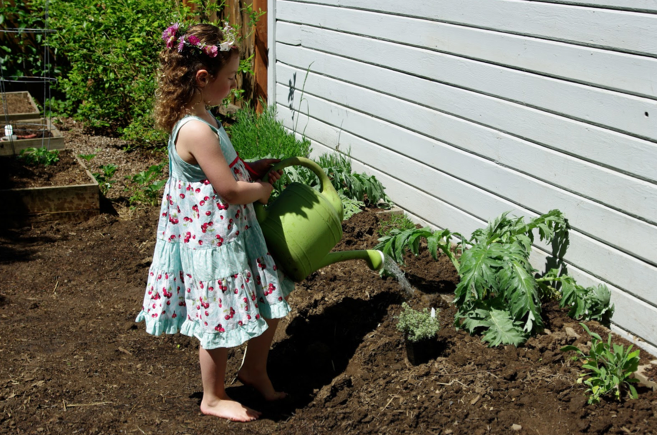
A Good Choice for a Child’s Garden                                                                                Child in garden 1          If your love of gardening and native plants has inspired your little one to start his or her own plot, Clarkia is a good wildflower to start with.  A high percentage of the seeds will germinate in 5-6 days, if sown indoors in early January.  Just sprinkle a few seeds over some dampened planting mix in small pots, cover with a little more soil, and don’t let the soil dry out.  When the seedlings are about 2 inches tall, they can be transplanted directly into the ground where they will get full sun, or sun most of the day, and keep them watered.  Remove weeds as soon as they appear.  And maybe protect the seedlings from slugs, snails and earwigs with a sprinkling of environmentally safe iron phosphate, until the seedlings get big enough.                                       Or, if you prefer, you can sow the seeds directly on the ground in the fall and wait for the autumn rains.  They will bloom in March or April.  After the spent flowers are trimmed off, they may re-bloom a second time.  You may plant more seed in early spring for blooming in late spring.  Clarkia re-seeds itself readily, so you can expect to see more seedlings coming up in the same place the following year.                                                             Or plant some in pots and some in the ground, and see what works best for you!
Child in garden 2Seeds can be purchased inexpensively from the Larner Seed Company in Bolinas (www.larnerseeds.com), although there is a minimum purchase of $20 if you order by credit card.  However, you might want to order seed packets of a couple of other Clarkia species in order to see the variety, and/or other types of California native wildflowers.  California poppy (Eschscholzia californica) is another good choice for a child’s garden, and Larner’s can suggest other wildflowers you might want to try.  Miner’s lettuce (Claytonia perfoliata) doesn’t have an impressive flower, but it does have an unusually cute perfoliate leaf, and it is edible, resembling butter lettuce or spinach in a salad.  And it re-seeds itself freely, from year to year.                                                   A list of suggestions for a child’s garden is too long for this edition of the Granada Native Garden.  If you would like to see the list, just email Jim at  JIMatGNG@gmail.com, and he will forward it to you!

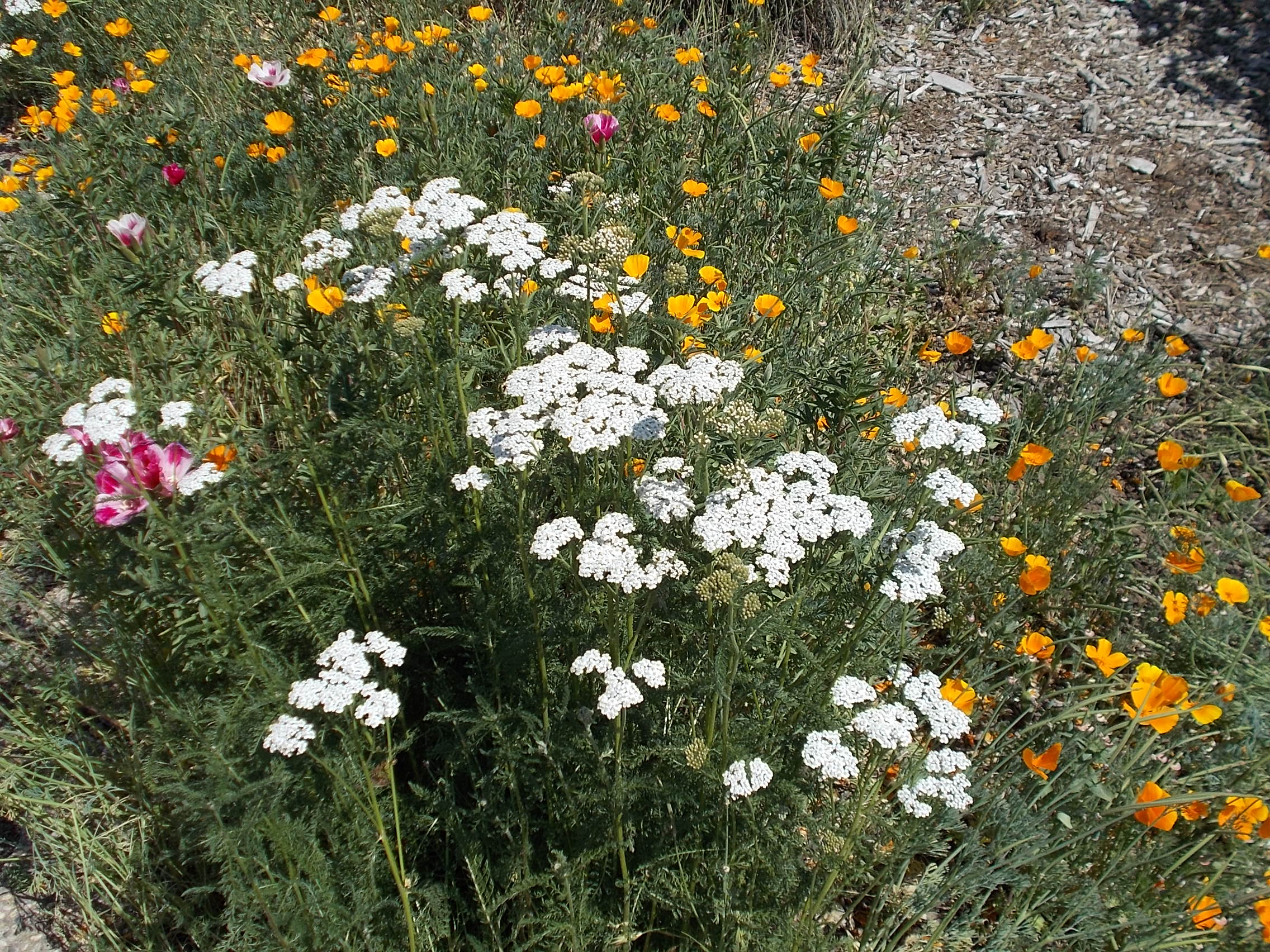
Other Current Attractions                                                                                                          Visit the Granada Native Garden soon, and see if you can locate these two flowers that are currently in bloom.  Or better, let your little one(s) explore the Garden and find them for you!  (Maybe he or she will want to start a California native plant garden!)

Yarrow, white variety

Yarrow, white variety

Yarrow, pink variety

Yarrow, pink variety


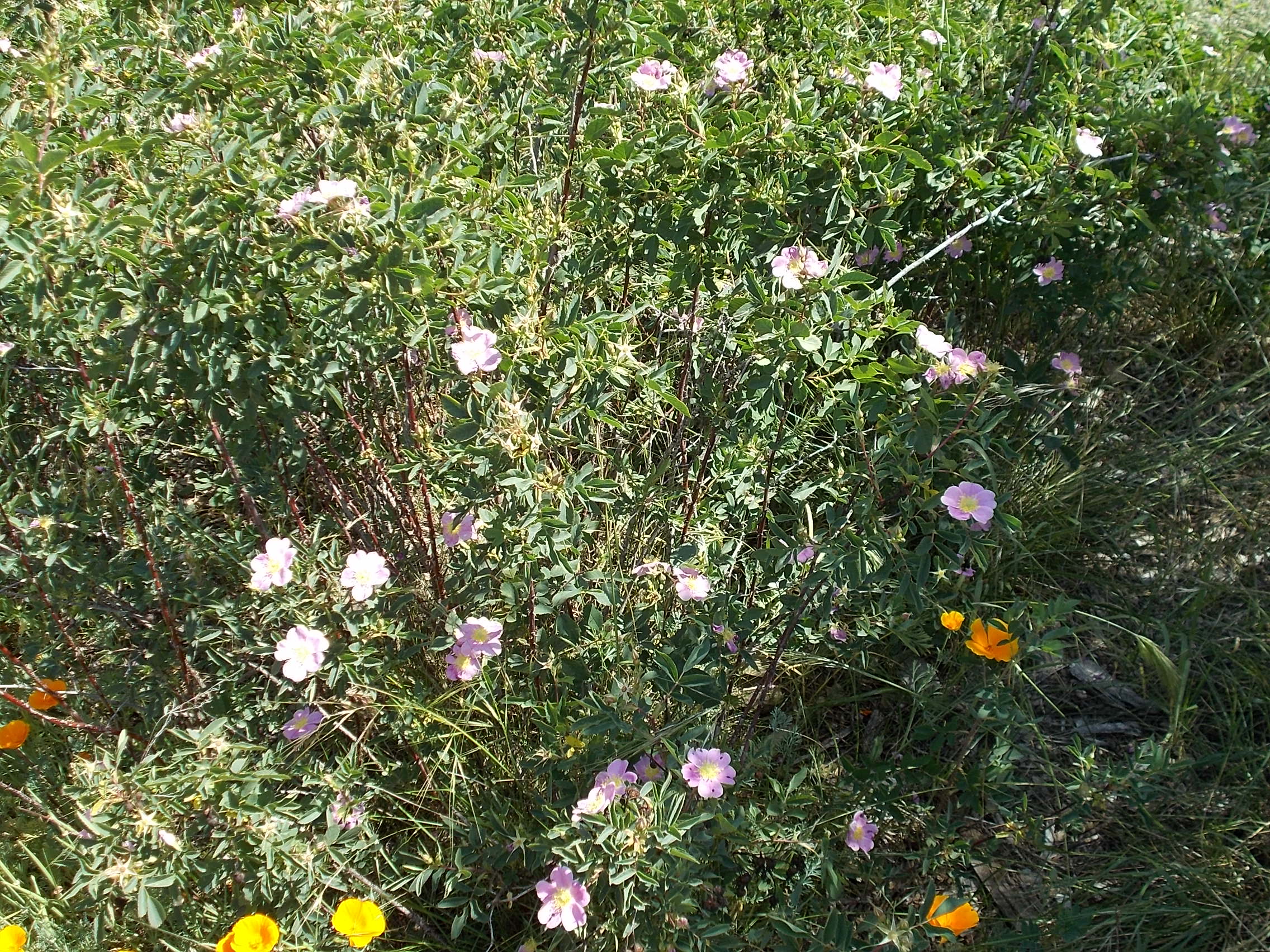
California wild rose

California wild rose

Quote du Jour:                                                                                                                            “I’ve been obsessed with plants since I was 8 or 9 years old, particularly the plants I found in the woods and fields around where I grew up on the Connecticut River.  I used to drive my family nuts, because it was all I would talk about.  I remember my mom once raising her hands in frustration and saying ‘Can’t you talk about anything besides plants?’  Now, they’ve just kind of accepted it and we all talk about plants a lot when I’m visiting them.”                                                                                                                                                                       – Peter Veilleux, owner of the East Bay Wilds nursery, Oakland, CA

Screen shot 2014-04-17 at 8.05.51 AM

Current Attractions – Earth Day, 2014


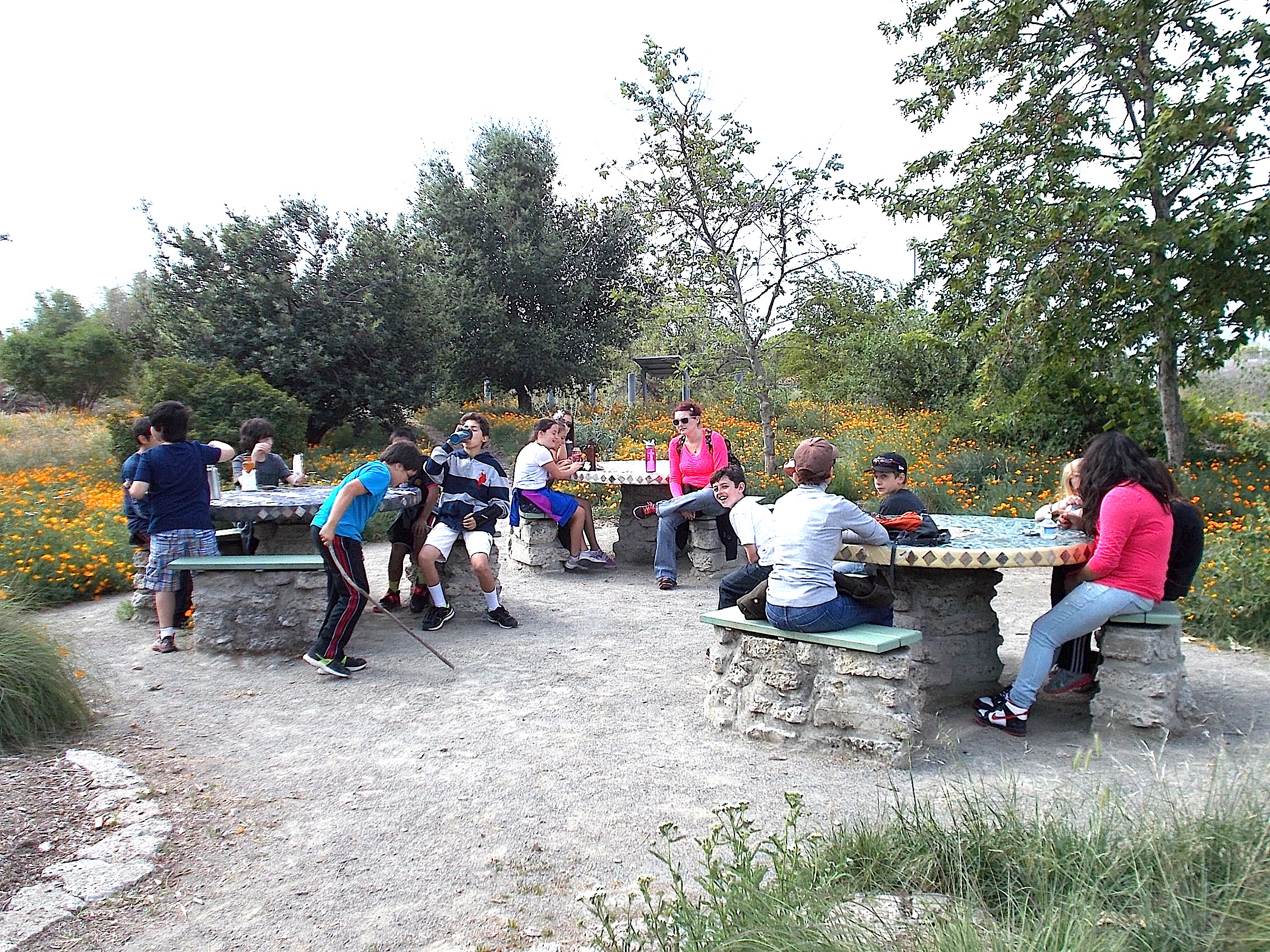
Smith School 3Smith School Discovers the Granada Native Garden!                                                            Recently, a class of 5th Graders from Emma C. Smith School stumbled upon the Granada Native Garden when they stopped to have lunch during a mini-field trip:  “We never knew it was here!“.  There they learned some things about the importance of plants to the native people who lived in California before the Europeans arrived – such as how gumplant (Grindelia sp.) had many medicinal uses, in addition to being a cheap substitute for chewing gum, owing to the sticky substance that collects in its young flowers and coats its leaves.  And many of those plants are growing at the Granada Native Garden, waiting to be discovered.

Speaking of Discovering …                                                                                                        William Rasor, a biology teacher at Granada High School, recently visited the Granada Native Garden with his camera, and found these attractions which are currently in bloom there.  He generously shared his photos with us.  They speak for themselvesBut the Garden is constantly changing, so they might not be there for long.  (Hint:  To enlarge a photo, just click on it.)          

Rasor 1

Early buckwheat flowers

Buckeye flowers, just before they open

Immature buckeye blossoms


Late-season California poppies

Late-season California poppies

Poppies with lupine

Poppies with lupine


Redbud flowers

Redbud flowers

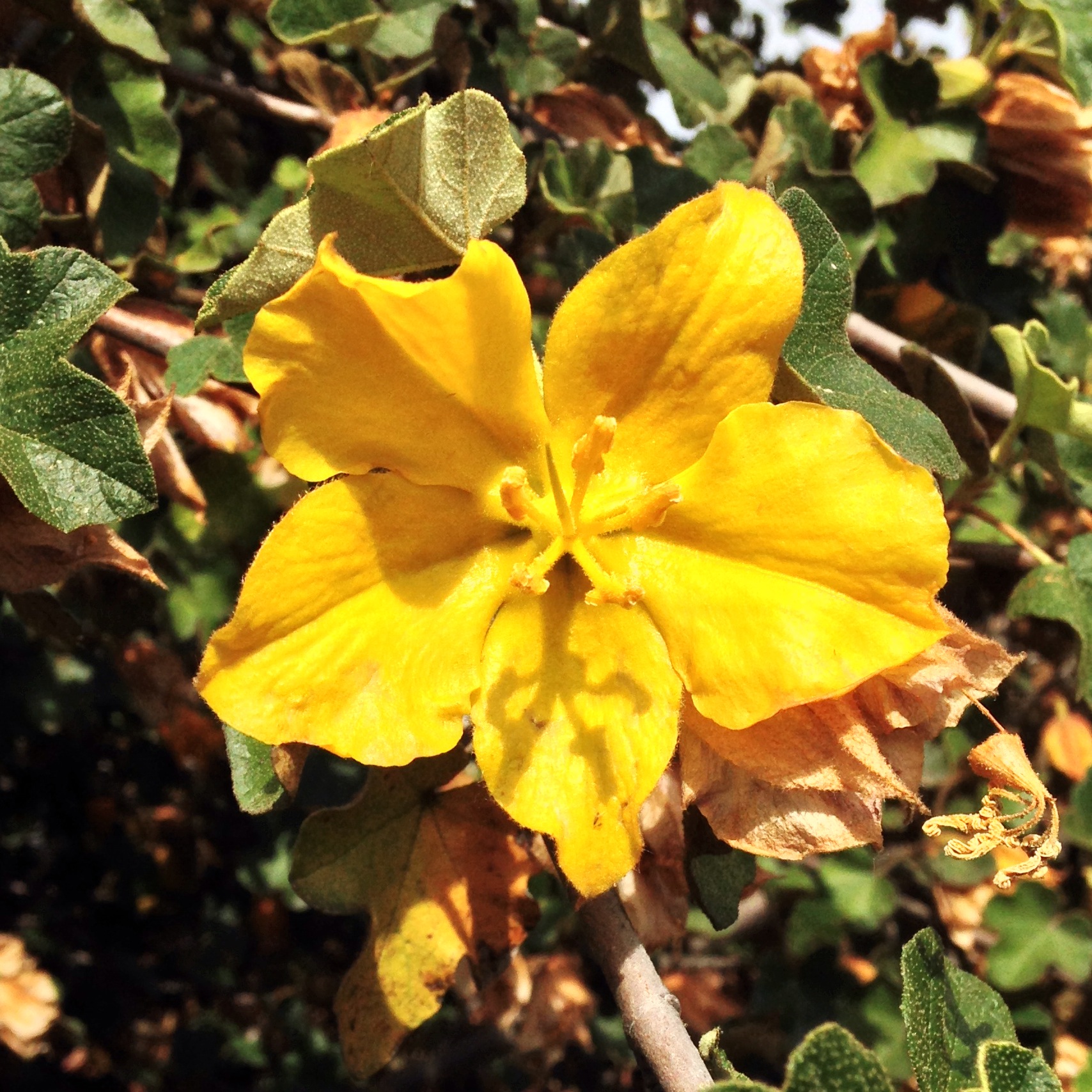
Flannelbush blossom

Flannelbush blossom


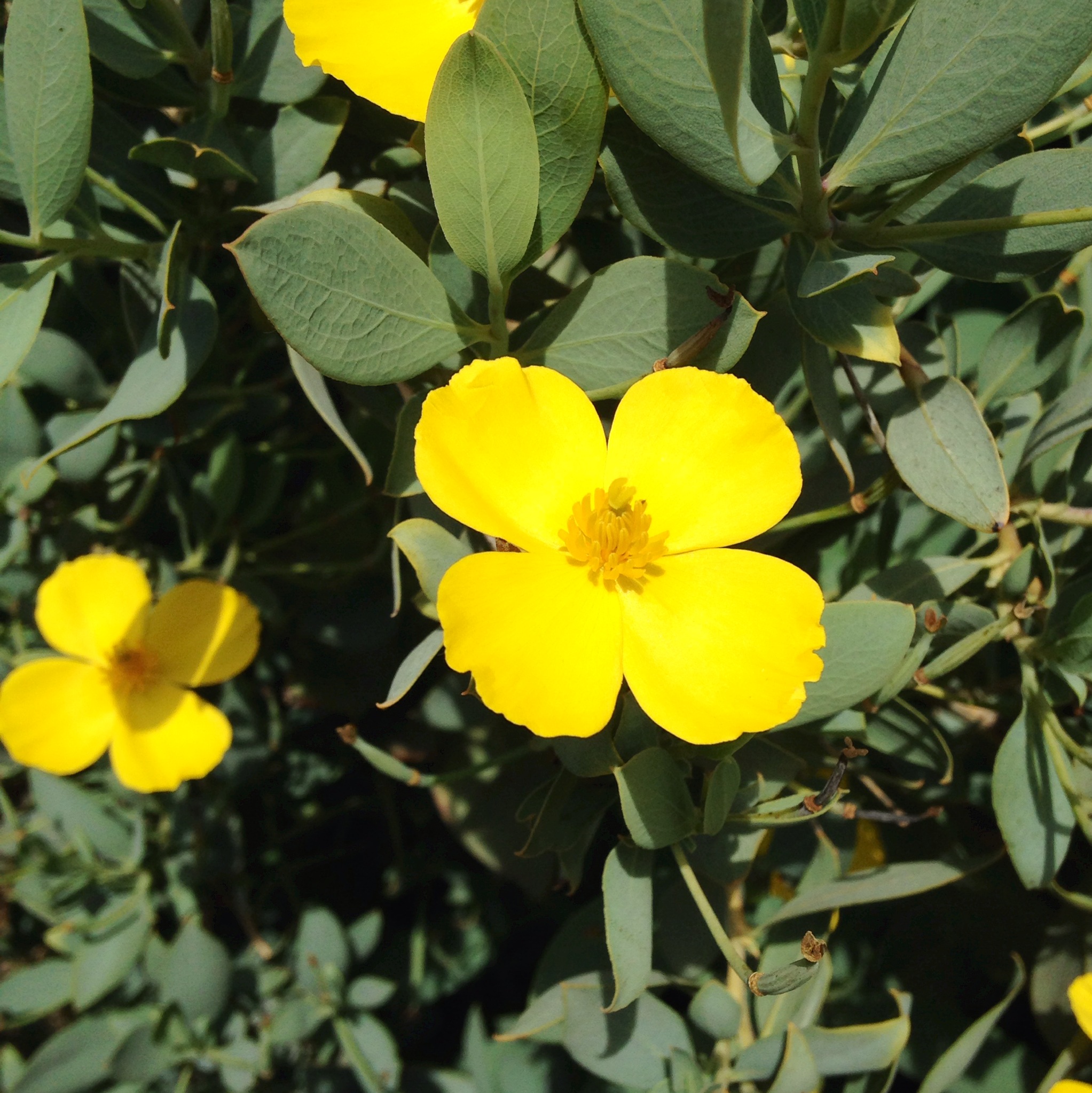
Bush poppy

Bush poppy

Yarrow, first of the season

First yarrow of the season


Smith School 2

Thanks for the memories, William And thanks to the students and teachers at Smith School — come again soon, and bring friends!


A Reminder to Visitors to the Granada Native Garden …                                                                              Holly-Leafed Cherry ID

         You might find some white tubes next to some of the plants at the Garden.  No, they are not sprinkler heads – they are identification markers that tell you what the plant is and why it is important.  You may lift the tube off its support to read it, then put it back when you are done.


Screen shot 2014-04-17 at 8.05.51 AM

The Colors of Spring


Poppies & Lupine 1

We weren’t planning on posting an article so soon after the previous one (on “Precocious Poppies”, archived in February, 2014), but a visit to the Granada Native Garden impressed us so much with the different colors that are currently on display made it imperative that we share them with our Followers.  So this post is mostly an album of photos (with very little added commentary) of the many colors that are on display as April begins.                          The field of poppies (Eschscholzia californica) and a couple of purple companion lupines (Lupinus sp.) are, of course, the first to meet the eye when you arrive.  But a casual stroll around the Garden will reveal many more details that are more or less obvious, but equally striking.  Some of these plants have already been written up in detail in earlier posts (see the Index to learn which ones), and others will be added in the coming months (or years).  EnjoyAnd visit the Granada Native Garden before they transition to the next seasonal generation!

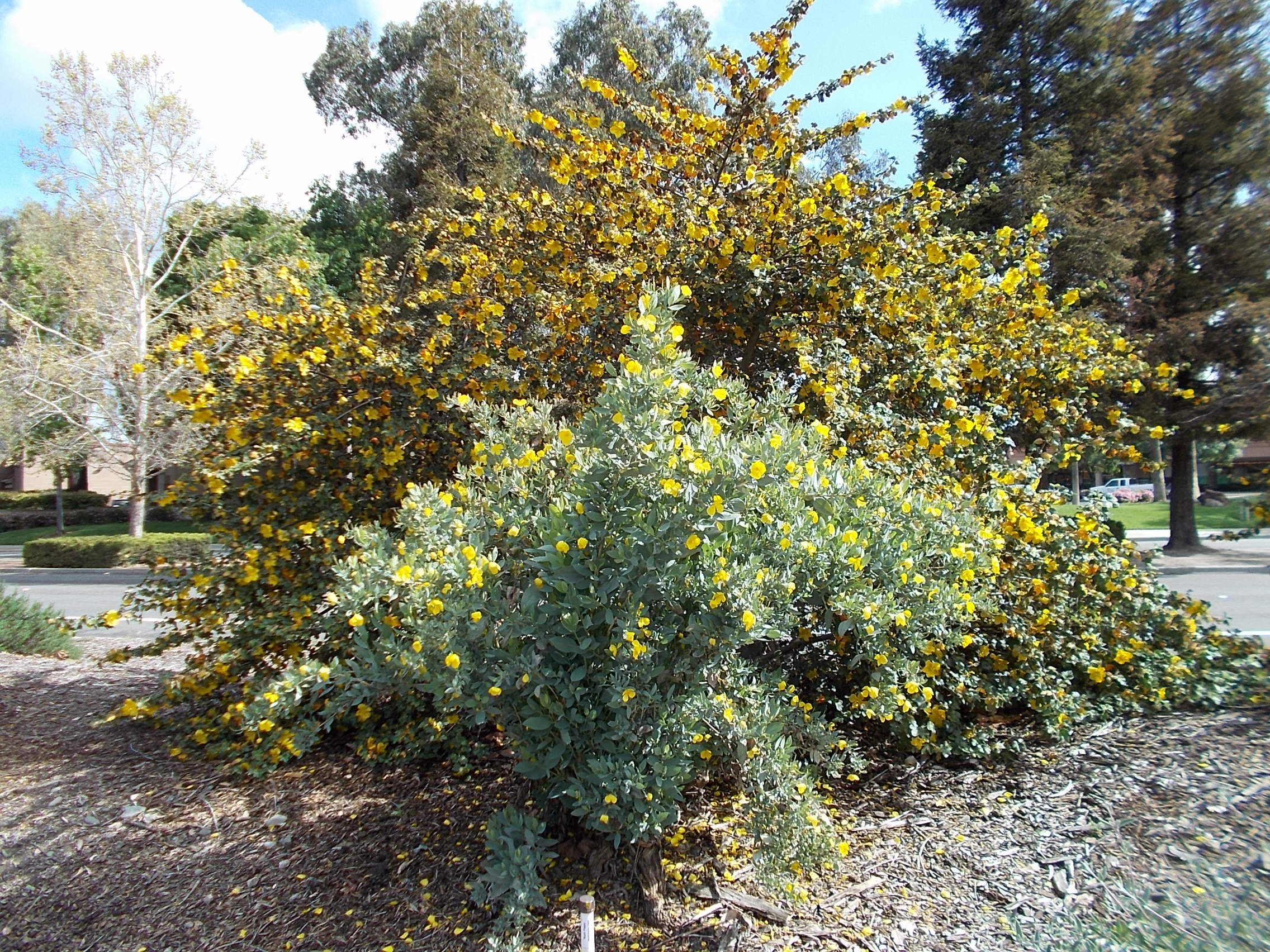
Bush poppy-Flannelbush

Bush poppy, in front. Flannel bush in the rear.

At the north end of the GNG, along the chaparral birm, the bush poppy (Dendromecon rigida, above, in front) and one of many flannel bushes (Fremontodendron sp., behind the bush poppy) are in full bloom.  You can’t miss them!  (Hint:  To enlarge a photo, just click on it.)

Cercis

Western redbud

Snowdrop

Snowdrop


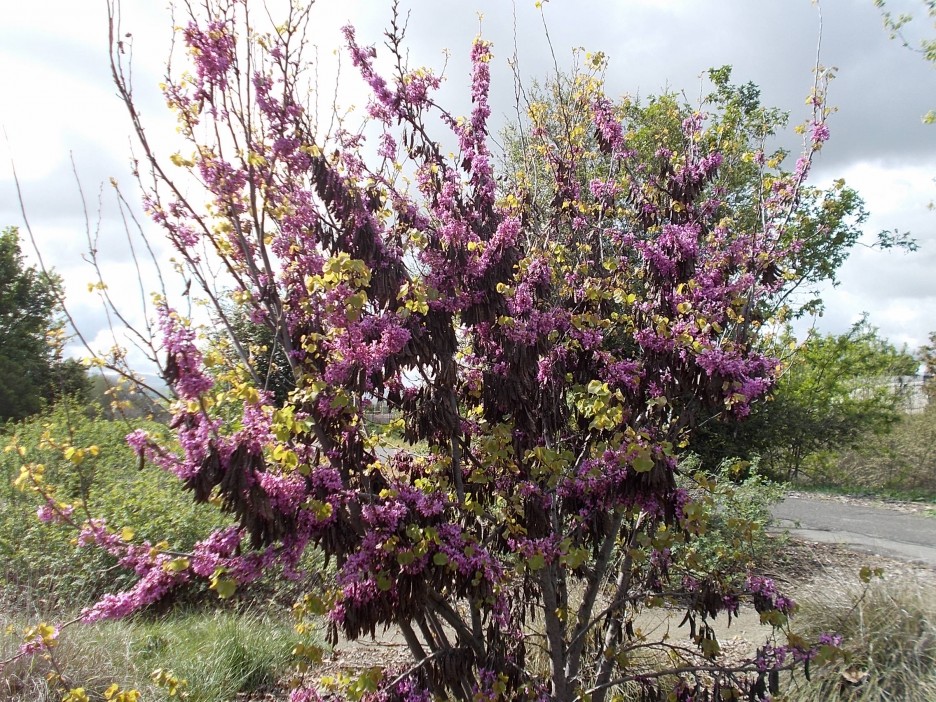
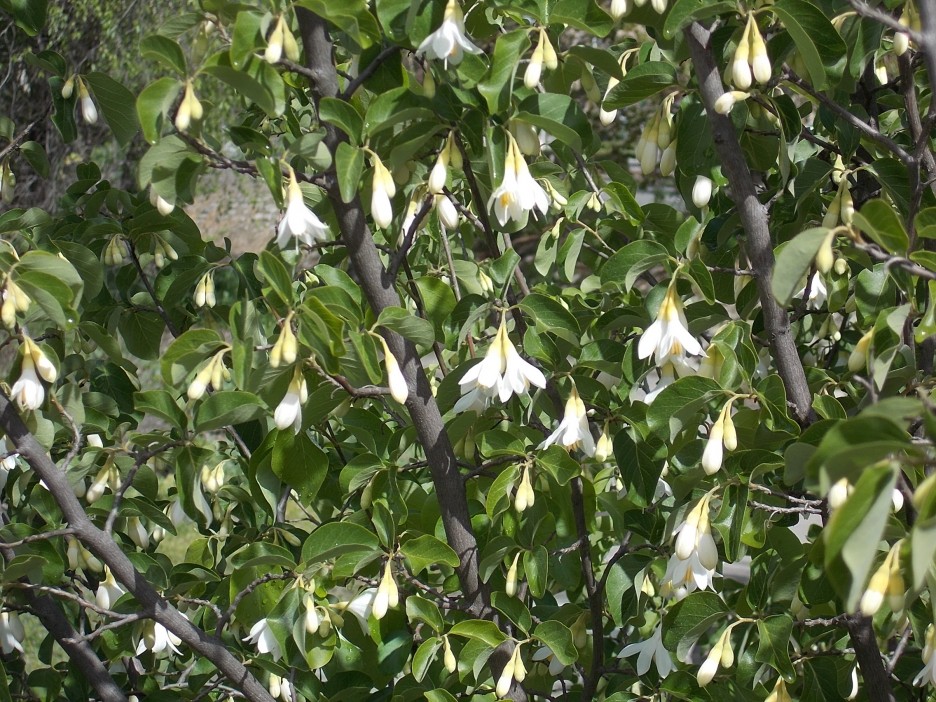
Near the same part of the Garden, the snowdrop (Styrax officinalis) has cute little white pixie-like blossoms that last only for a couple of weeks before they fall off like a light dusting of snow on the ground.  Catch them before it’s too lateMore attractive but only from a distance, the mauve flowers of the western redbud (Cercis occidentalis) might seem to conflict with last year’s brown seed pods, but,  hey!  brown is a color too!

Lupine 1

Arroyo lupine

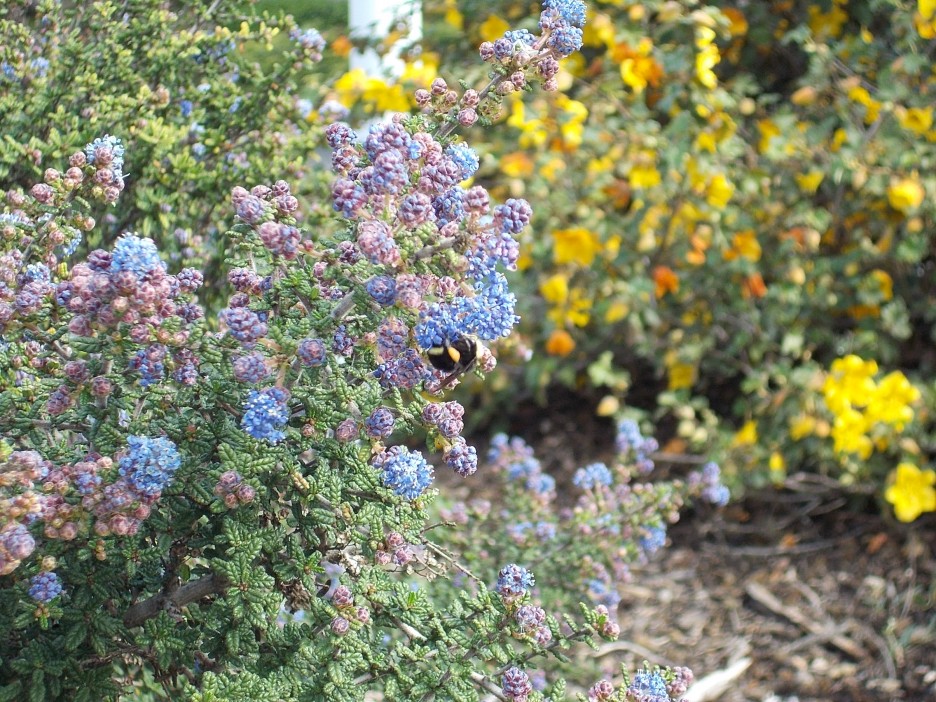
'Dark Star' ceanothus with a worker bee

‘Dark Star’ lilac with a worker bee


California buckeye, with immature blossoms

California buckeye, with immature blossoms


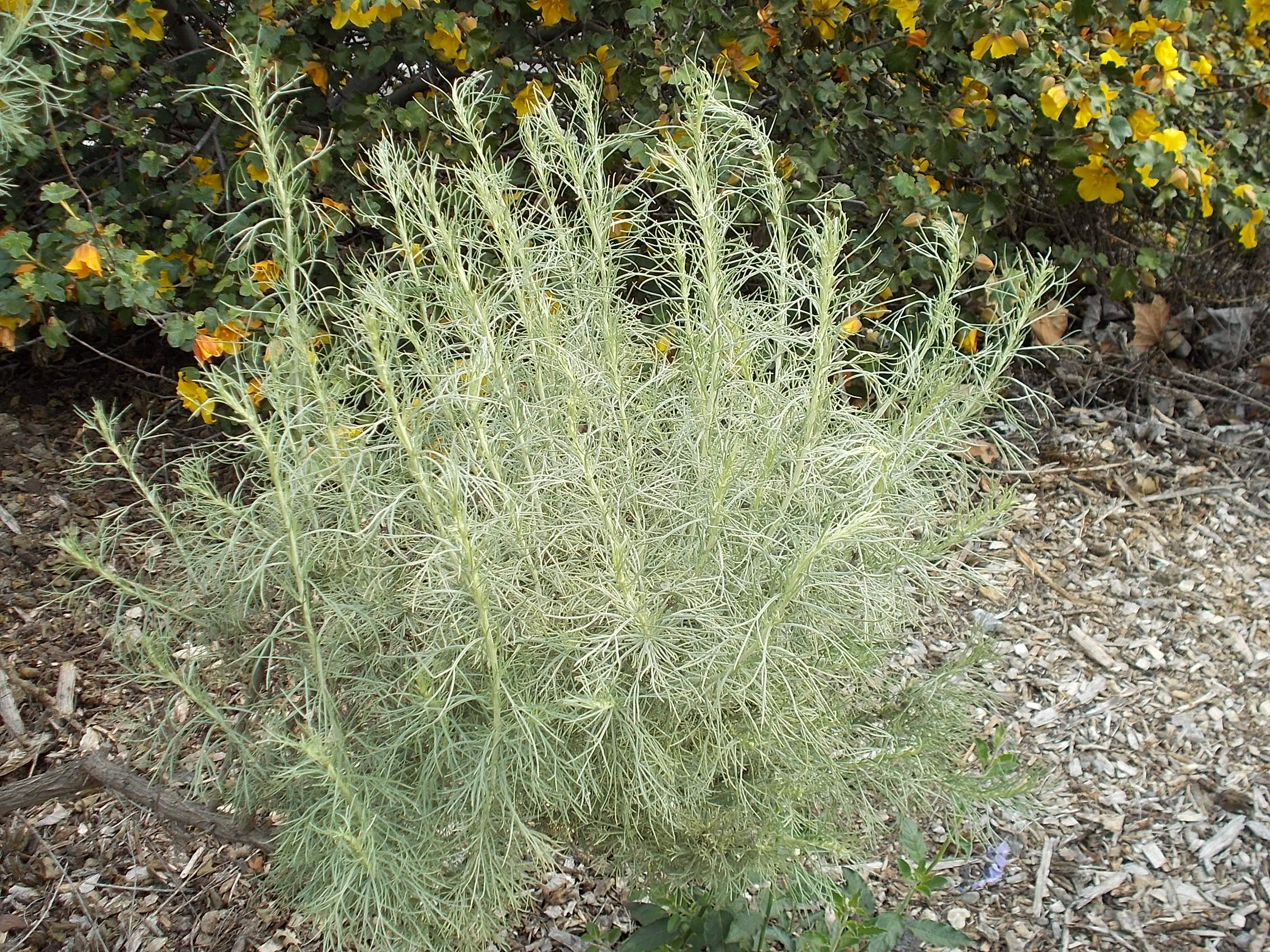
There are more than 50 shades of green.  Explore the Garden and see how many you can find.  Here are three of them.  (Sorry, but we’re not sure which of the native bunch-grasses this one is! )

Sagebrush, with new foliage

Sagebrush, with new foliage

Grass

Native California Bunchgrass


 Surprise Appearances!                                                                                                  

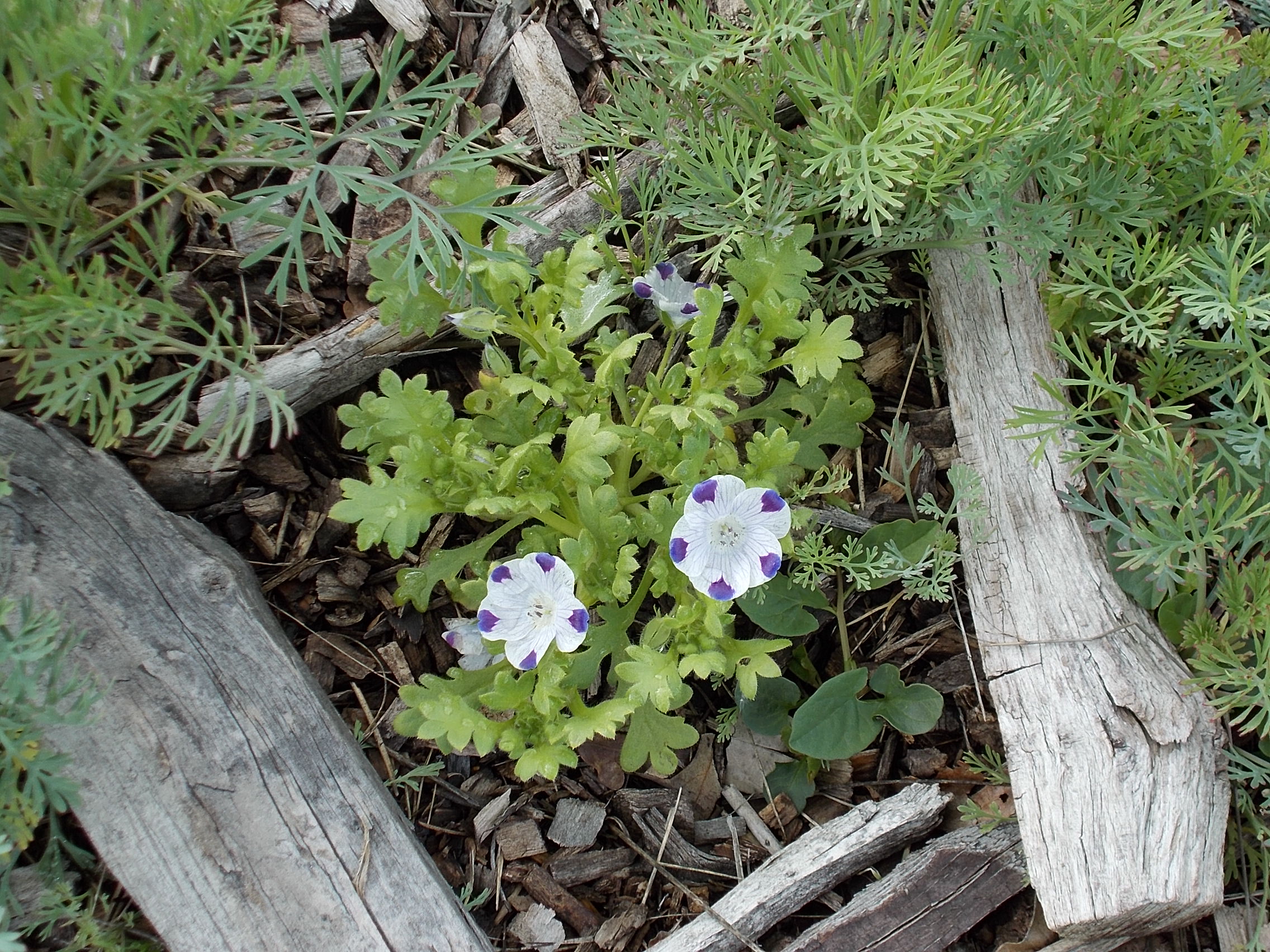
Five-Spot (Nemophila maculata)

Five-Spot (Nemophila maculata)

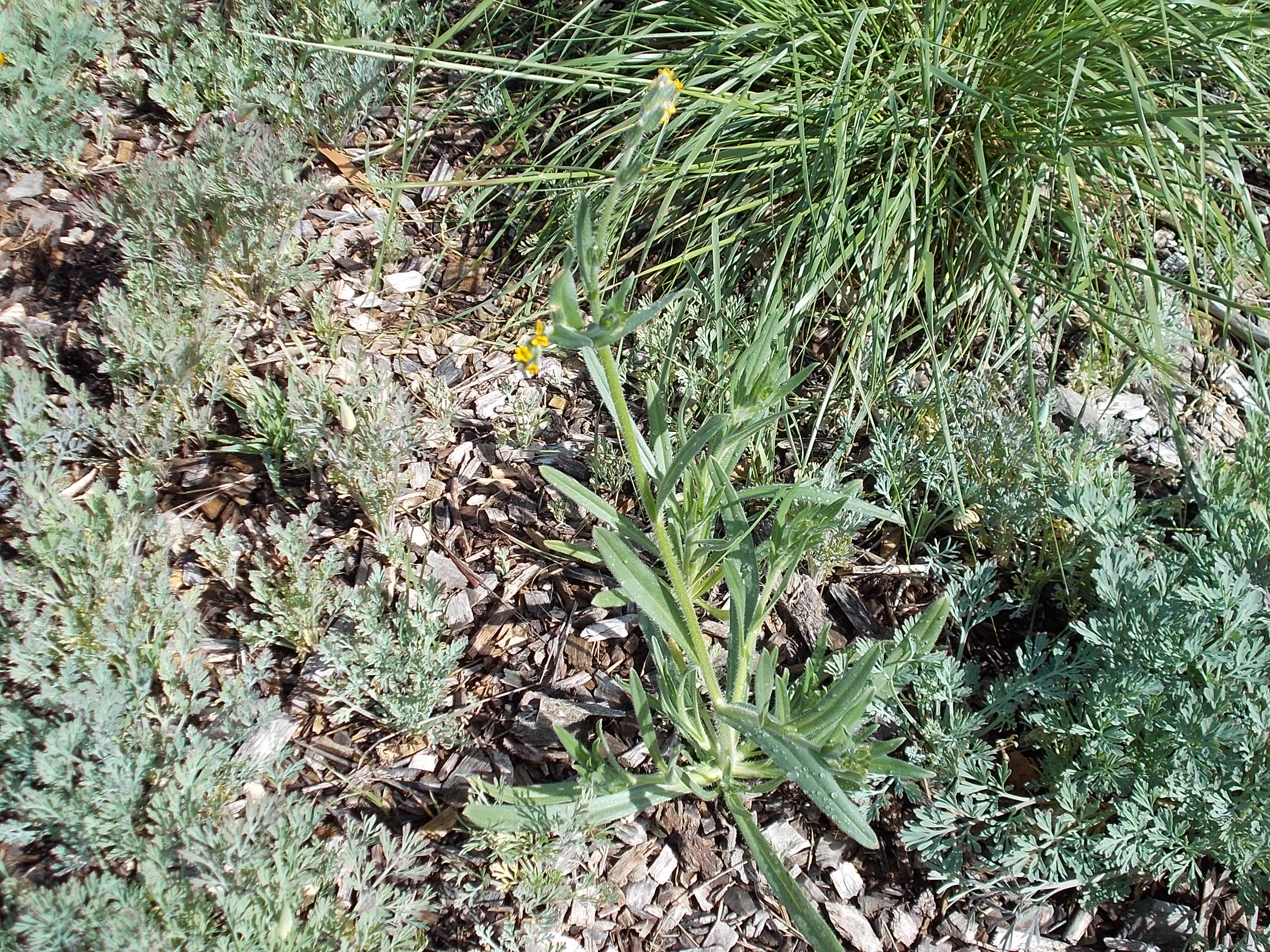
This spring three new flowers appeared at the Granada Native Garden.  They weren’t planted or seeded by anyone other than, perhaps, birds or the wind, and you have to know where to look.  But they are welcome arrivals, and hopefully they will re-seed themselves so we will see them again next year, and become permanent wildflowers at the Garden.  Here they are; again, click on each photo in order to enlarge it and get a better look.


Fiddleneck (Amsinckia menzeii)

Fiddleneck (Amsinckia menzeii)

Scorpionweed (Phacelia ciliata)

Scorpionweed (Phacelia ciliata


Two New Worker Bees!                                                                                                              Mike and Linda have joined the staff at the Granada Native Garden.  Mike is on sabbatical leave from Las Positas College, and Linda is a new Livermore resident.  Whenever their time and schedules allow, they join Jim, Mary Ann, Kerry, Dave, Malvika and Kirpa to keep the Garden looking good as the seasons change and work needs to be done.

LindaMike


Screen shot 2014-04-17 at 8.05.51 AM


Precocious Poppies & Other Signs of Spring (Feb-Mar, 2014)

Precocious Poppies          After a relatively bleak winter at the Granada Native Garden, with many natives dormant or slow to emerge because of the limited rainfall this winter, all is not lost!  There are signs of spring all over the place, but you just have to know what to look for.                   Take these poppies, for example.  Coaxed into blooming a few weeks early because of some extra water shared with a caged-in baby bigberry manzanita planted last year, they anticipate the display of California poppies (Eschscholzia californica) which usually floods this section of the Granada Native Garden in March and April, depending on the rainfall we get.

Ribes aureum (3-21-13)But the real eye-catcher this month are the golden currants (Ribes aureum), of which there are several currently (please forgive the unintended pun!) in bloom, like the one above along the bikeway at the north end of the Garden; an identification marker is there to help you find it and tell you about it.  Bees love the blossoms now, but later in the season, the blossoms form small purplish-black berries, the currants, which were an important food source, fresh or dried, for Native Americans — exactly the way we use raisins now.

A busy carpenter bee on golden currant

A busy carpenter bee on golden currant

Buckeye (2-20-14)

The buckeye – very much alive!

        And those visitors who thought our buckeye was dead might be surprised to see it in full leaf again.  That’s the life-style of the California buckeye (Aesculus californica).  It loses its leaves in late summer in order to conserve water; then it comes back in full foliage in the early spring.  Stunning blossoms will follow in May, and golf-ball size seeds later in the summer.

Less obvious additions to the Granada Native Garden are the soap lilies (Chlorogalum pomeridianum).  Last year we planted 12 of them at the north end of the garden, and 3 more at the south end.  All of them are leafing out now.  In May, they should be sporting tiny, lily-like blossoms several inches above the basal cluster of leaves.  We will write about those interesting plants, so very useful to the Native Americans, in a future post.

Soap lily

A soap lily, not yet flowering

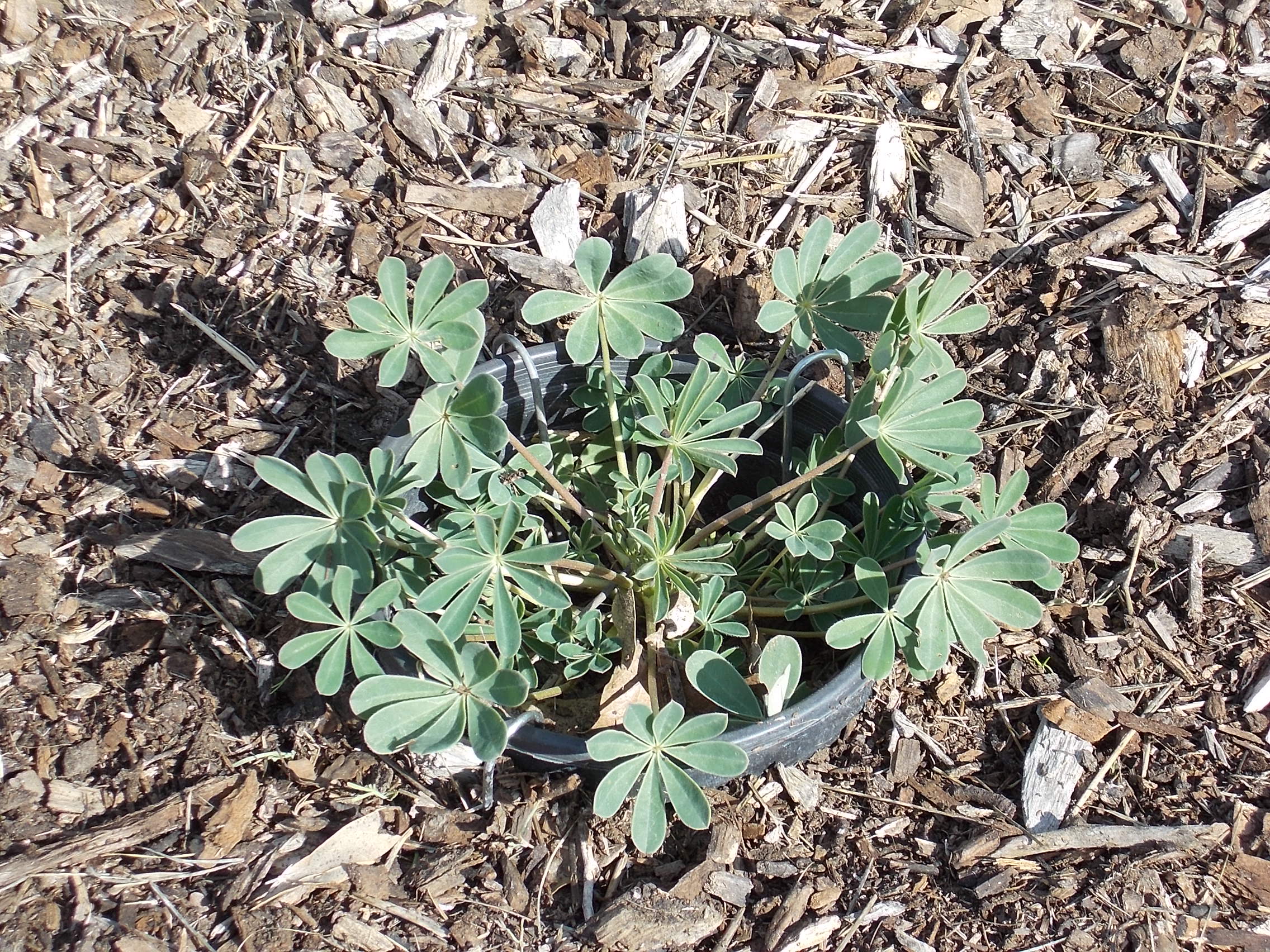
Lupine

One of many lupines

And last year we made an attempt to increase the population of blue and gold lupines at the Granada Native Garden, because they are such colorful harbingers of spring (a separate post about lupines was posted on April 29, 2013 and can be viewed in the April, 2013 archives).  We germinated a few lupines in pots for transplantation recently, but we also spread seeds of both types in the Garden.  The lupine above is one that was started from pots.  The lupines from scattered seeds are just now appearing in the Garden, and we are looking forward to seeing them brighten up the Garden when they mature.  Lupines self-seed freely from year to year.  Unfortunately they are also reportedly highly relished by slugs and snails!

Other Coming Attractions                                                                                                          The early season native grasses, especially purple needlegrass (Stipa pulchra, formerly Nassella pulchra) and California melic (Melica californica) are appearing in bright green at this time of the year.  The Garden’s lone native sycamore (Platanus racemosa) and the ubiquitous interior wild roses (Rosa californica) are showing their first leaves.  A little harder to find is the bed of flat-topped goldenrod (Euthamia occidentalis) which threatens to take over the south end of the Garden.  Last year’s Farewell-to-Spring (Clarkia amoena) is popping up again around the table area.  We recently saw this year’s first flower on the columbine (Aquilegia formosa), one of the Garden’s original members.  And California aster (Aster chilensis), which is supposed to go dormant at the end of the summer, never did entirely disappear, even without much rain.  All of these will be much more evident in the coming months.  So take a walking tour thru the Garden, and look for these and other signs of springLook closely, and you’ll be surprised how many things you may find.

Quote du Jour:                                                                                                                    “If you have a garden and a library, you have everything you need.”                                                     – Marcus Tullius Cicero, Roman philosopher, politician and orator

Screen shot 2014-04-17 at 8.05.51 AM

Coyote Brush – An Under-Appreciated Native

Coyote brush

Why Is It Called Coyote Brush?                                                                                         As far as I can determine, no one knows for sure why this underrated native plant is called “coyote brush”, Baccharis pilularis.  Perhaps the best explanation is that coyote brush (or “bush” as it is sometimes called) is very adaptable and comfortable in different habitats, soil types and climates.  A similar suggestion is that it grows in the same habitat as that of coyotes; but coyotes aren’t especially particular about their habitat either, as long as their prey is available (an irreverent and scientifically untenable explanation is that it pops up wherever coyotes happen to have urinated).  Another possibility is that the seed pods have a crown of white hairs that give the appearance of a mass of fluffy white flowers – maybe resembling coyote fur?  More than one writer agree that it propagates very readily, both from its abundant seeds and from the roots, and that it “is very difficult to get rid of once established”, leading to the question of whether you consider it a blessing or a curse.                                                                                                                                    Another mystery is the origin of the scientific name, Baccharis.  The name refers to Bacchus, the Roman god of wine and various convivialities, among other things.  But how this is related to the plant, no one seems to be very sure of that either!

Fluffy blossoms

Fluffy blossoms

Why Is It Underrated?                         I once learned that there is a fan club dedicated to the advance- ment and popularization of coyote brush.  When one sees coyote brush growing in the wild, you might wonder what the attraction is all about.  With its small leaves and inconspicuous, fluffy blossoms, it isn’t particularly appealing or showy.  In fact, as it gets older, most of the growth is at the tips, and the branches look rather bare and skeletal.  For this reason, many native plant gardeners recommend that older specimens be coppiced, that is, cut down to the ground every few years.  Because of its large tap root system, the plant readily grows back.  This is especially important after a fire or flood has devastated an area, because coyote brush is one of the first shrubs to appear after other plants have disappeared.  For that reason, coyote brush is called a pioneer species.  When someone set fire last year to a field of dry needlegrass at the Granada Native Garden, the coyote brush growing there was scortched on one side, so I cut out the burnt part.  The photo at the right shows the re-growth just a few months after the fire.Recovery after a fireCoyote brush, showing its tap root

So although coyote brush isn’t exactly an eye-catcher, it is useful horticulturally for hedges and fence lines, and as a background plant where its 6-8 foot height towers above shorter plants, but it can get up to 12 feet high and looks best when it is cut back occasionally.  The specimen in the photo at the top was planted from a seedling only 2-3 years ago in poor soil and was watered only for the first year, and not very regularly at that.  So it isn’t particular about its habitat.  Like a coyote.

Small leaves help conserve water

Small leaves help conserve water

However, there is a dwarf form of coyote brush, ‘Pigeon Point’, which is highly regarded as a low-growing ground cover, especially for a slope where erosion control is important.  In addition, it is fire-resistant, has dark to medium green foliage that contrasts nicely with ceanothus (California lilac), toyon and manzanita, and doesn’t get woody in the middle.

An Insect Magnet                                                     Coyote brush fans and admiring horti-culturists aren’t the only ones who prize coyote brush.  It is an important habitat plant for birds and butterflies, and attracts predatory wasps, skippers and native butterflies.  Las Pilitas Nursery says that “you will see the weirdest bugs on these plants”!   The plant is dioecious (“dy-ee-shus”), which means that male flowers and female flowers are found on separate plants.  Furthermore, it flowers at the end of the summer and into fall, providing a late source of nectar and nutrients for insects that need to over-winter.

BlossomsSo, Just What Is That Smell?                  Some varieties of coyote brush
are said to have a honey-like fra- grance which attracts many butter- flies.  One native plant devotee reports that “Long before I knew what coyote brush was, I noticed its delightful and aromatic herbal fragrance when hiking near the Sonoma Coast, where it grows in profusion”.  When we lived in Sacramento and I often biked along the American River Bicycle Trail, I enjoyed the medicinal odor of sagebrush (Artemesia), especially on hot summer evenings when the odor can easily be detected in the air, and of coyote brush, which reminded me of motor oil.  Lori, a friend who visited us recently, asked me if there is coyote brush in our yard, because she could smell it even from a distance.  There is, in fact, one single coyote brush in one corner of our yard; Lori eventually concluded the aroma reminds her of dill.  As if to agree with Lori, another commentator describes the fragrance as “unmistakable” and “intoxicating”, like “a fresh blast of sweet dill and sea air”.  Still another says that the male flowers smell like shaving soap.  In any case, the aroma (and taste) apparently seems to help protect it from being eaten, especially by deer.  Whatever it smells like, it is just something else that contributes to our pleasure and enjoyment of California native plants!

Pop Quiz!
We have introduced three important concepts in this post.  Without looking back, see if you remember what is meant by these terms:  pioneer species, coppice, and dioecious.  No cheating now!

The Practical Film & Media Workshop                                                                     Chepeka         The Practical Film and Media Workshop is a vocational program designed to provide adults with developmental disabilities an initial entry-level working knowledge of film produc- tion and related industries, then to build those skills over subsequent twenty-week work- shops.  Late last year, the PFMW chose the Granada Native Garden as a site to film a skit written, played and directed by the students of the Workshop.  The weather cooperated nicely, and the event exceeded their best expectations.

The Prophet

The Prophet

The skit involved the inhabitants of an small fictitious frontier town, Chepeka, and one individual who has prophetic powers and is warning of an impending catastrophe.  None of the citizens believe him, until he is befriended by one special person who convinces the citizens of Chepeka of his authenticity.  In the end, Chepeka is saved (if you can overlook the 21st century evidences in the background)!

Quote du Jour:
“There is a place for this indispensable shrub in every California garden!”                                                                                                                                              – From the Tree of Life Nursery

Screen shot 2013-07-24 at 8.34.45 AM

Toyon – California’s Native Christmas Tree

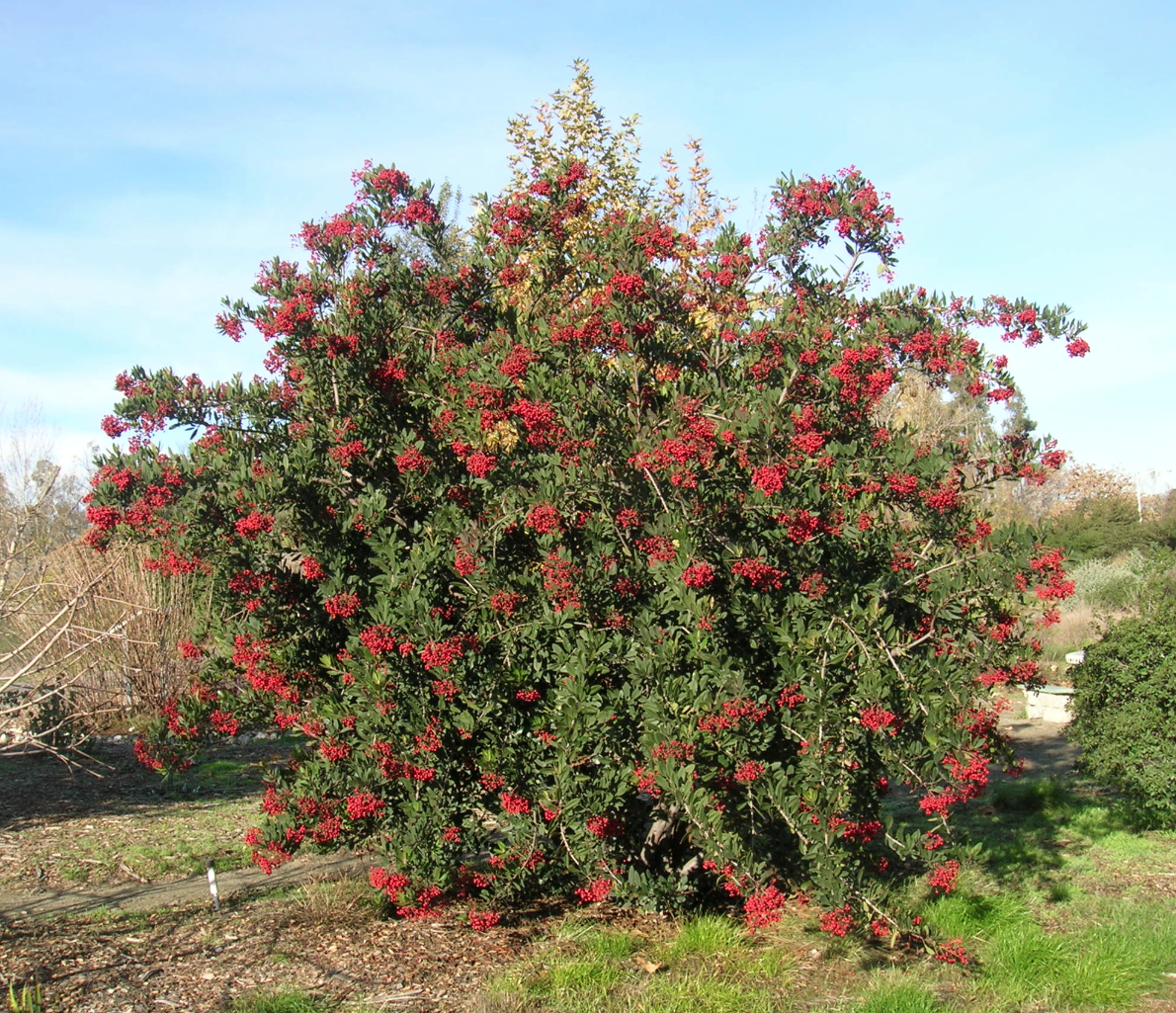
Toyon at the GNG, December, 2012

Toyon at the GNG, December, 2012

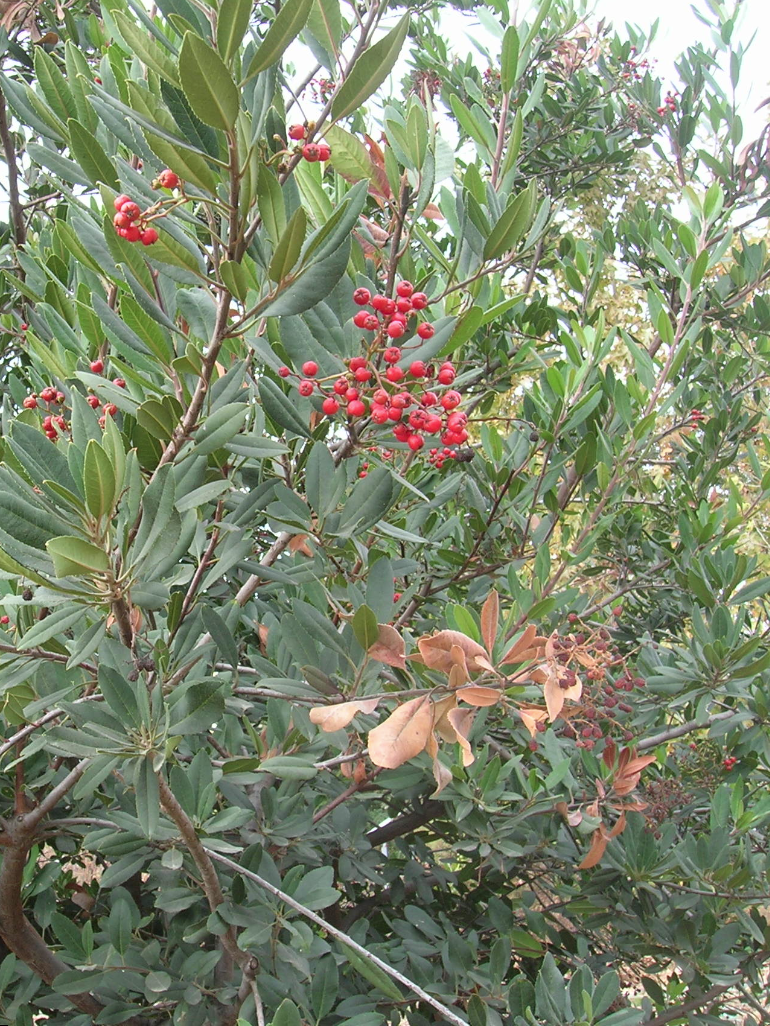
          With its dark evergreen leaves and clusters of bright red berries that ripen precisely in time for Christmas, the toyon (Heteromeles arbutifolia) is also called California Holly and Christmas Berry.  It is the basis of the name “Hollywood”, because the hills in that part of southern California were populated with toyons.

          In fact, collecting toyon branches for holiday decoration became so popular in Los Angeles during the 1920s that the State of California made it illegal to harvest “any tree or shrub … growing on state or county (property) … without a written permit from the owner of the land” (CA Penal Code § 384a).  Of course, the cedar waxwings, robins, mocking- birds and other birds that feast on the berries are exempt from the law!

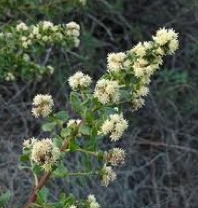
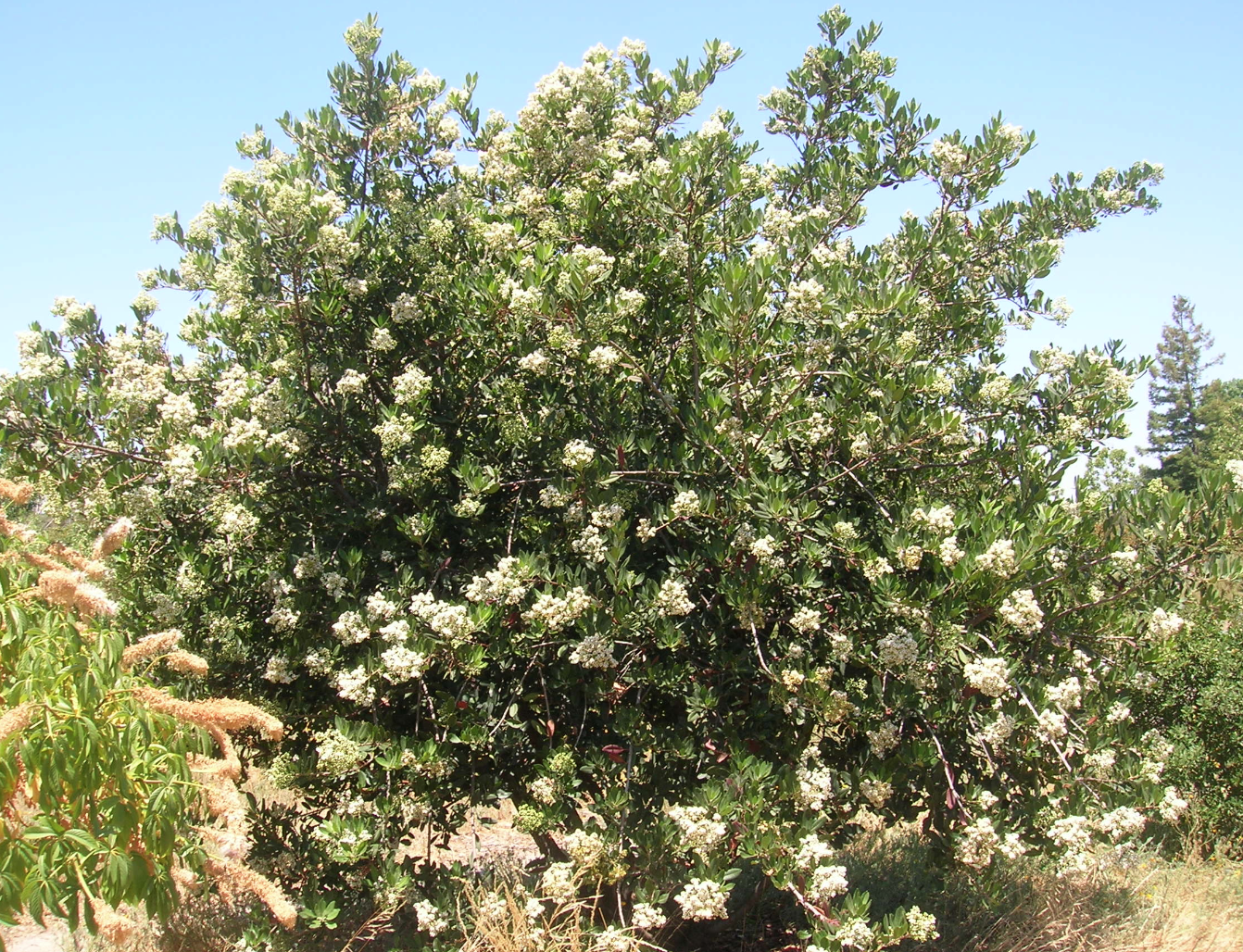
Toyon, June 2013

Toyon, June 2013

Choosing Toyon for Your Landscape                                      If you have enough space, your multi-stemmed toyon can spread out up to 15-20 feet tall and equally wide.  But if you pinch it back a little each year, it will remain dense and manageable.  Just be sure to prune it back after the berries ripen but before the new flowers form in early spring, or you will end up pruning off next season’s berries (a mistake Jim made his first year at the Granada Native Garden).  Time it right, and you will be rewarded in late spring with an equally dramatic display of white blossoms.

Toyon’s Importance to Native Americans                                                                         Most of the plants at the Granada Native Garden were used by the Native Americans in one way or another – for food, medicine, tools or clothing.  Like a number of other native plants, toyon berries contain a small amount of toxic cyanide-forming compounds “which can kill you if you eat a few pounds”.  But the toxic ingredient is removed by cooking or roasting, and the berries were gathered by many Indian tribes (Chumash, Tongva, Tataviam) and roasted over coals or boiled, then mashed and eaten out of hand, or made into a jelly or a beverage, or dried and stored for cooking into porridge.  Tea made from the leaves was used as a remedy for upset stomach.

Fire Blight?

Fire Blight?

Fire Blight?                                                 The toyon at the Granada Native Garden has had no water except what falls from the sky during the winter.  Toyon is a member of the family Rosaceae, which includes pears and apples.  (Botanically speaking, this also means that the berries are not true berries, but rather miniature pomes, like apples and pears.)  These fruits are famously susceptible to fire blight, a disease caused by a bacterium, resulting in the youngest leaves of some branches turning brown and drying up; the disease can destroy limbs and even entire shrubs or trees.  This year, we suspect that fire blight has attacked our toyon!  We hope that it eventually overcomes the attack and regains its former splendor.

GNG Sign 1Current Updates                                                      The Granada Native Garden is now identifiable to passersby, thanks to an anonymous benefactor who made signs (the one that says “Granada Native Garden”, not the other one) for each of the three entrances to the GNG!                                                              The GNG is becoming a destination!  Last spring, when the poppies were in full bloom, one family considered the Garden as a location for an engagement party.  And this month, the Practical Film and Media Work- shop, a vocational program designed to provide adults with developmental disabilities an initial entry-level working knowledge of film production, has chosen the GNG as a site to produce a film about their activities.  The precise date and time has yet to be confirmed, and of course it depends on the weather.

Quote du Jour:                                                                                                                    “If Californians ever decide to have an official state shrub, toyon would be a fitting candidate.”                                                                                                                                                                                                                                                      – Marjorie Schmidt, in Growing California Native Plants

Screen shot 2013-07-24 at 8.34.45 AM

Planting for Pollinators

Tiger swallowtail on toyon

Tiger swallowtail on toyon at the Granada Native Garden

Mariposas                                                                                                                                There are a number of places in California named “mariposa”.  There is the town of Mariposa in Mariposa County, California.  There is the famous Mariposa Grove of sequoias in Yosemite National Park, and the Mariposa Bakery in Oakland.  Not to mention any number of streets around the state and country named mariposa.                                                 Why “mariposa”?  Mariposa is the Spanish word for “butterfly”, and the sight of butterflies made a big impression on the first European visitors to California.  Padre Pedro Muñoz recorded in his diary that he had observed thousands of tortoise-shell butterflies (Nymphalis californica) possibly at what is now Mariposa Creek.  M. Kat Anderson quotes the Native American elder, Pauline Conner, reminiscing about the time when the wild- flowers were so abundant that “butterflies would come in clouds and you could reach out and touch them.  Sometimes they would land on you.”  These included the buckeyes, anise swallowtails and orange sulfurs.                                                                                  Monarch           Numerous concerns have been raised about the extensive decline in the numbers of monarch butterflies in the last several years.  The blame has been laid on herbicides which reduce the food source (milkweed) of the monarch larvae, on genetically modified organisms, on the destruction of forests in Mexico where the butterflies hibernate, and on droughts and wildfires in critical parts of the country thru which the monarchs pass.  The naturalist, David Attenborough, states that he used to see buddleia bushes covered with red admiral butterflies, but now he sees practically none.

Red admiral

Red admiral

Butterflies are widely accepted as good indicators of ecosystem health.  For that reason, the overall decline in butterfly populations is an alarming result with important implications for other insects and biodiversity.  And butterflies are only part of the picture.  The bees, birds, bats and beetles are equally important to maintain healthy ecosystems and ecological balance.  Messing with an eco- system is a risky business; unfortunately the nega- tive, potentially disastrous effects are not likely to be convincingly obvious for several years, or too late.

Screen shot 2013-10-30 at 5.53.40 PM          Fortunately, many people are becoming aware of the implications of the loss of our native butterflies, and are taking steps to encourage more of them back into our environment by planting California native plants.  Here is a list of butterflies that have been observed and documented several years ago by Ranger Dawn Soles at Sycamore Grove Park.  To her list I have added the most common host plants used by their larvae and adults; plants that can be found at the Granada Native Garden are in italics.

                                                                                      
Acmon Blue (Plebejus acmon acmon)                                                                                  Variety of food plants such as Atriplex canescens, Eriogonum spp., Dudleya spp.,            Lupinus spp., Astragalus sp., Lotus spp., Asclepias, Baccharis
American Lady (Vanessa virginiensis)
     Artemesia, aster, goldenrod, milkweed, vetch, Prunella                                               Anise swallowtail (Papillo zelicaon)                                                                                     Members of the carrot family (parsley, dill, fennel).
Cabbage White (Pieris rapae or Artogeia rapae)                                                                 Members of the cabbage family; crucifers, nastursiums, horseradish; a great variety         of flowers.
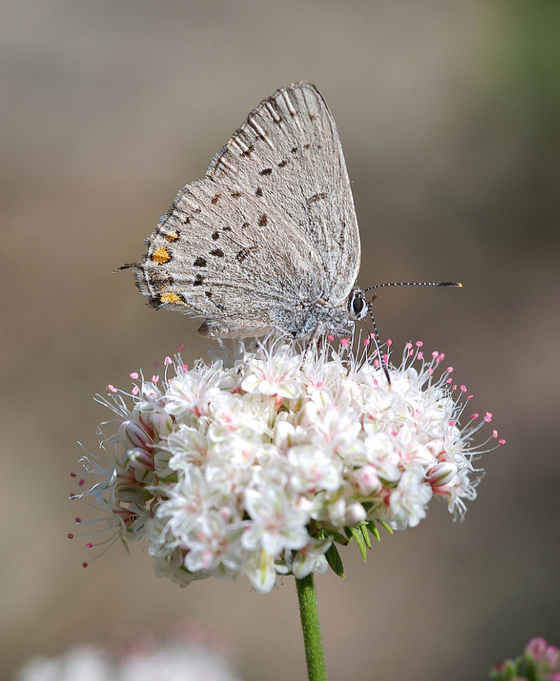
California Hairstreak (Satyrium californicum)                                                                      Serviceberry, Prunus virginiana, Cercocarpus, California lilac, oak, willow, buckwheat.

Hairstreak on buckwheat

Hairstreak on buckwheat

California Ringlet (Coenonympha tullia california)                                                                Grasses
California Sister (Adelpha bredowii)                     Oaks, buckeye, toyon                                       Checkered White (Pontia protodice)                    Members of the mustard family; composites,          legumes, alfalfa “and almost everything else”.
Common Buckeye (Junonia coenia)                    Plantain, monkey flower, rabbitbrush, sage,              coyote brush.
Common Checkered Skipper (Pyrgus communis)                                                              Mallow; numerous nectar plants
Coronis Fritillary (Speyeria coronis)                     Rabbitbrush, Viola, buckeye, aster, goldenrod, thistle                                                    Creamy Marblewing (Euchloe ausonides)                                                                            Members of the mustard family (this butterfly is rare and apparently close to                     extinction because of loss of habitat and its native host plant, Guillenia lasiophylla)Fiery skipper (Hylephila phyleus)                                                                                      Nectar from flowers of a variety of plants including sweet pepperbush, swamp milk-         weed, asters and thistles.

Fiery skipper on tomato

Fiery skipper on tomato

Gray Hairstreak (Strymon melinus)                      Flowers and fruits from an almost endless                variety of plants, most often from pea                 and mallow families, including beans and                clovers.                                                       Great Copper (Lycaena xanthoides)                     Nectar of various flowers; several dock                   species.                                                             Great Purple Hairstreak (Atlides halesus)        Mistletoe growing on native oaks, sycamores    and cottonwoods.

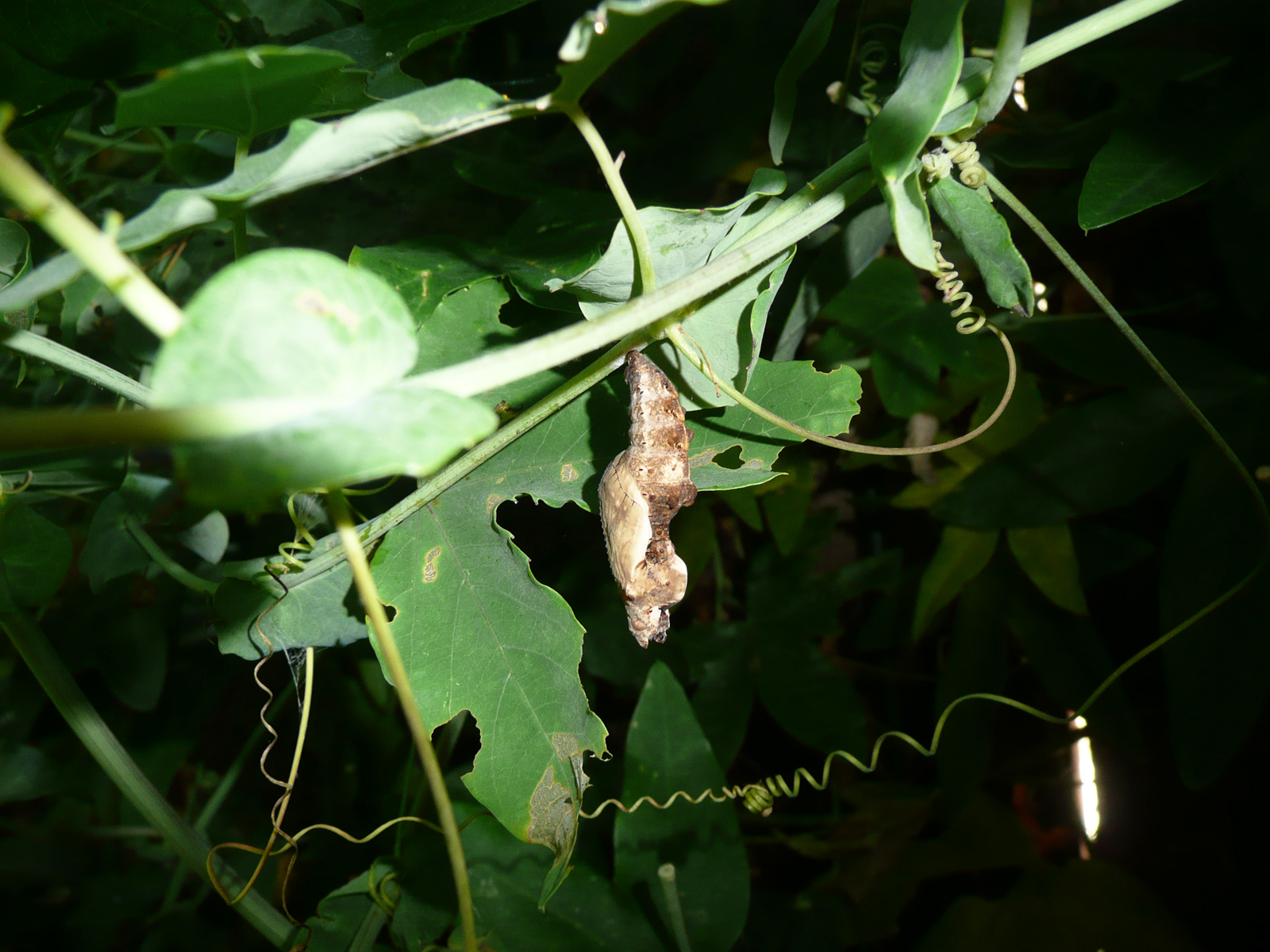
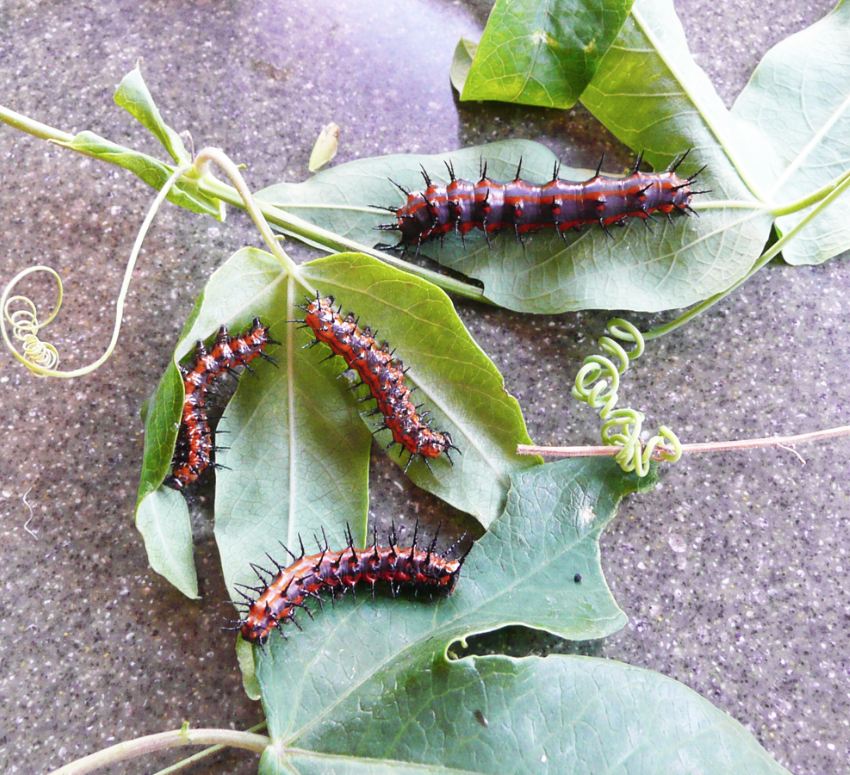
Gulf Fritillary (Agraulis vanillae)                                                                                         Nectar from lantana, shepherd’s needle, cordias, composites, passion vine, and              others

Gulf fritillary chrysalis

Gulf fritillary chrysalis

Gulf fritillary larvae

Gulf fritillary larvae

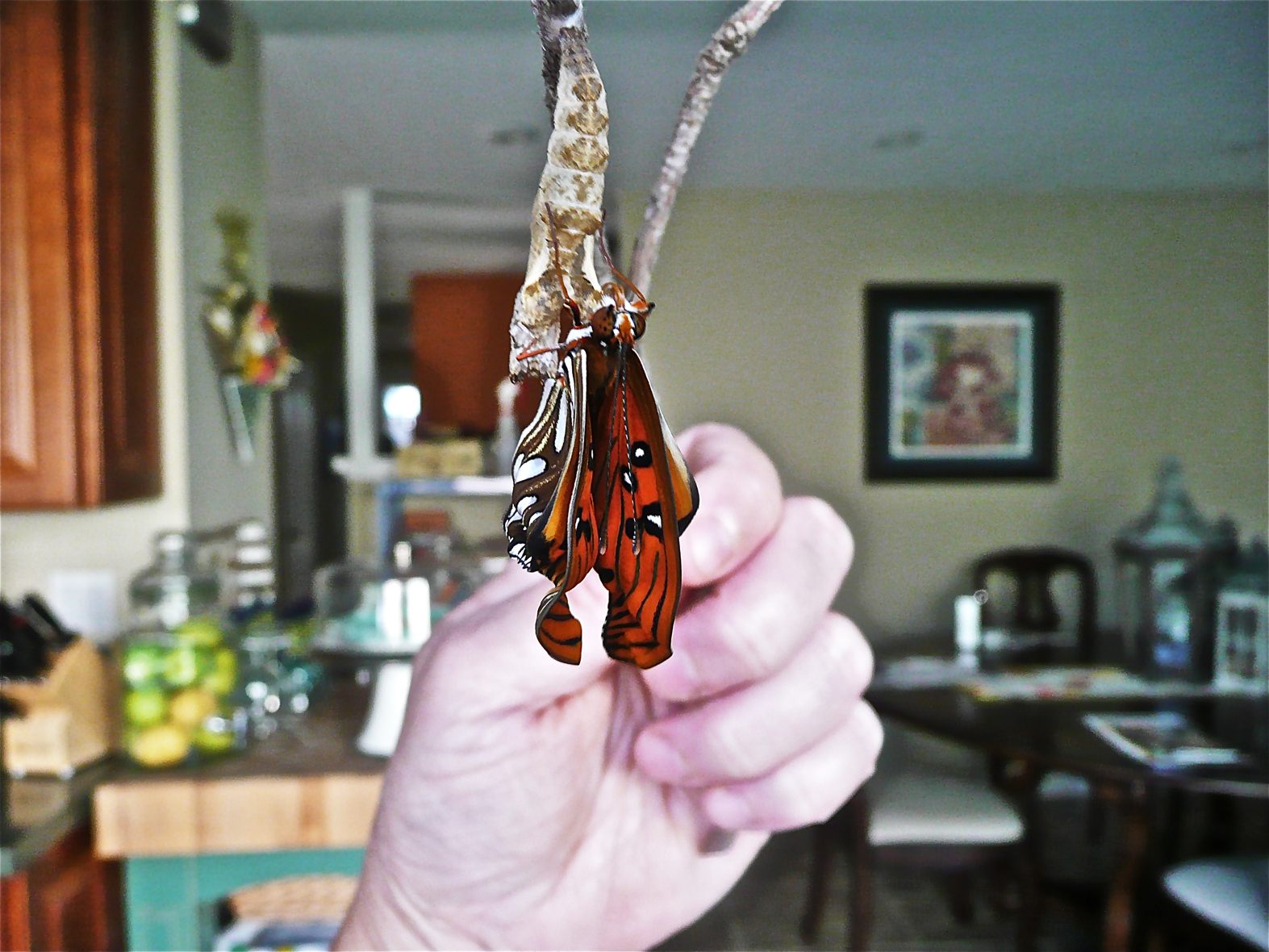
The finished product!

The finished product!

Mature adult emerging from the chrysalis

Adult emerging from the chrysalis


Lorquins admiral (Limenitis lorquini)                                                                                      Willow, rabbitbrush                            Lupine Blue (Plebejus lupinus)                                                                                          Several species of buckwheat.  Flower nectar.
Monarch (Danaus plexippus)                                                                                             Milkweed; numerous nectar plants
Mourning Cloak (Nymphalis antiopa)                                                                               Willow, rabbitbrush
Mylitta Crescent (Phyciodes mylitta)                                                                                Many flowers, including thistles, yerba santa, heliotrope, rabbitbrush                       Orange Sulfur (Colias eurytheme)                                                                                         Members of the pea family.
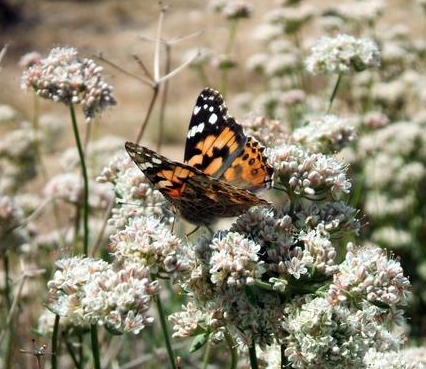
Painted Lady (Vanessa cardui)                                                                                              Asteraceae, rabbitbrush, thistles, mallows, numerous others.

Painted lady on buckwheat

Painted lady on buckwheat

Pale swallowtail (Papillo eurymedon)                                                                                   Members of the Ceanothus family, including California lilac, buckbrush, mountain                balm, red alder, bitter cherry, serviceberry, coffeeberry, California buckeye, yerba                  santa, and wallflower.
Red Admiral (Vanessa atalanta)                                                                                            Milkweed, clover, aster, alfalfa
Sara Orangetip (Anthocharis sara)                                                                                       Members of the mustard family.
West Coast Lady (Vanessa annabella)                                                                                  Mallows (including cheeseweed)
Western tiger swallowtail (Papillo rutulus)                                                                           Leaves of a variety of trees and shrubs; commonly cottonwood, willow,                               quaking aspen, yerba santa, California buckeye, milkweed, dogbane, lilies, coyote             mint, lilac (Syringa), buddleia, sycamore, ash, cherry and other stone fruits, willow,             privet, sweet gum.

More Help Planting for Pollinators                                                                                    A very useful field guide for identifying local butterflies and selecting their host plants, as well as information about the natural history of the butterflies, is the Field Guide to Butterflies of the San Francisco Bay and Sacramento Valley Regions, by Arthur M. Shapiro and Timothy D. Manolis.                                                                                                         Dr. Shapiro is an instructor at the University of California, Davis.  He also has a useful website, “Art Shapiro’s Butterfly Site”, at  butterfly.ucdavis.edu/crew/amshapiro.                    The Pollinator Partnership Guide, accessible at  http://www.pollinator.org/guides.htm, extensively lists butterflies and host plants specific for different regions of the State of California.
Kerry

Kerry hard at work at the GNG!

Many thanks to Ranger Dawn Soles for her list of local butterflies, and to Kerry Johnson for her photos of the gulf fritillary and the monarch feeding on buddleia!                      And thanks to the Rotary Club of Livermore for gifting the GNG with a grant to replace vandalized and weathered acrylic faces on our informational panels!                                Finally, many thanks to Jacquie and Alden Lane Nursery for helping us to replace many of the original plantings and to expand our display of native California plants!          

Quote du Jour:                                            “When you try to take something out of the Universe, you find that it’s hitched to everything else.”                                                                       ~ John Muir


Screen shot 2013-07-24 at 8.34.45 AM